 Skip to content
Honest comparisons for new readers, new Muslims and parents across the USA | Updated October 2026 | About a 23-minute read
Finding the best English Quran translation for beginners sounds like a five-minute job. Then you open an online bookstore, see dozens of titles, read a pile of reviews that contradict each other, and quietly close the tab. If that has happened to you, you are in good company. Muslim families across the USA, new Muslims, teenagers who grew up here, and parents who learned to recite without ever learning the meaning all hit the same wall. This guide cuts through the noise, compares the most trusted translations side by side, and helps you choose one that suits your family, your level and your goals. Whether you are searching for an English Quran translation, a Quran translation in English or simply the best Quran translation, the questions are the same, and the answers are simpler than they look.
Here is something worth hearing up front. Scholars who have been asked this question for years keep saying the same thing: there is no single perfect translation. Every translator makes choices, and every choice trades something for something else. That sounds discouraging, but it is actually freeing. It means you are not looking for the answer. You are looking for the right first book for you, and that is a much easier job. Think of it as Quran for beginners done the practical way: simple, honest and step by step.
Below you will find a clear comparison of The Clear Quran, Saheeh International, Abdel Haleem, Yusuf Ali, Pickthall, Asad and the Noble Quran, a guide by reader type, a 30-day reading plan, and the mistakes to avoid. And if you would like a teacher to walk through the meanings with you, our online Quran translation classes are built for beginners.
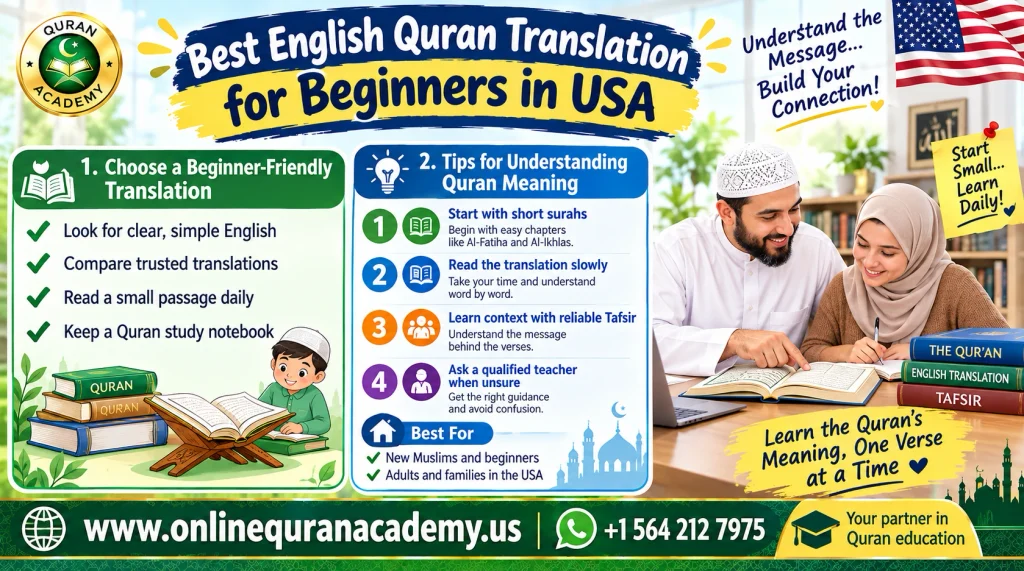
| The short answer (for busy readers) For most American beginners, the most commonly recommended starting points are The Clear Quran by Dr. Mustafa Khattab (modern, smooth English with headings and footnotes) and Saheeh International (plain English that stays closer to the Arabic wording). Choose Abdel Haleem’s Oxford translation if you want flowing, story-like reading. Whichever you pick, buy an Arabic and English edition, read a small amount daily, and talk through what you read with a qualified teacher. That combination matters more than the brand on the cover. |
How This Guide Was Put Together
I compared what teachers, scholars, publishers and everyday readers say about each translation, then measured every title against the same eight beginner checks you will see below. Where sources disagreed, I have said so honestly rather than pretending there is a single winner. Opinions about translations are partly personal, so treat this guide as a map, not a verdict, and let a trusted teacher guide your final choice.
Why Choosing the Best English Quran Translation for Beginners Feels So Confusing in America
Unlike some other scriptures, the Quran has no single standard English version that everyone uses. Walk into an Islamic bookstore in Houston, Chicago or New Jersey and you will see shelves of Quran books in English, including many different English Quran translations, each written in a different decade, for a different reader, with a different philosophy.
Part of the confusion comes from where people first meet an English Quran translation. Many families received a free copy from a masjid, a relative or a student group, and that copy might be written in English that feels closer to a 1930s novel than to the language your child speaks at school. Others find a translation through a social media post that says “the only one you will ever need,” which is rarely true.
There is also the issue of intent. Some translators aim for literal closeness to Arabic. Some aim for readability. Some add long commentary, and some insert explanations in brackets. A beginner who does not know these differences can easily pick a book that is technically respected but wrong for their level, then conclude that the Quran itself is “too hard.” It is not. The book was simply a mismatch.
So before comparing titles, it helps to understand what you are actually holding when you pick up a translation.
What an English Quran Translation Is (and Is Not)
This is the most important idea in the whole article, so let me say it plainly. A translation is a human effort to convey the meanings of the Quran in another language, which is what most people mean when they search for the Quran meaning in English. The Quran itself is the Arabic. That is why Muslims recite in Arabic in prayer, and why a translation is never recited in place of the original.
Arabic is a rich language where a single word can carry layers of meaning, and English often needs several words, or a footnote, to approximate it. Every translator has to decide: stay close to the wording and risk awkward English, or smooth the English and risk drifting from the wording. Neither choice is wrong. It is simply a different tool for a different job.
So think of any Holy Quran translation as a doorway to the Quran in English for your heart and mind. It opens the meaning to you so that your recitation becomes more heartfelt, but it does not replace learning to read Arabic, practicing Quran recitation, or studying under a teacher. This is also why scholars often encourage readers to compare more than one translation and, over time, to learn some Arabic.
| Quick answer: Can I learn the Quran from an English translation alone? A translation helps you understand the meaning, but it cannot replace Arabic recitation, Tajweed or guidance from a qualified teacher. Use the translation to understand, and a teacher to recite correctly and handle deeper questions. |
Words You Will Meet in Almost Every Translation
Opening a translation for the first time can feel like walking into a new city. A few key terms will make the signs readable:
| Term | Meaning |
| Surah | A chapter of the Quran. There are 114. |
| Ayah | A verse, sometimes called a sign. |
| Juz | One of 30 roughly equal parts of the Quran, handy for reading plans. |
| Mushaf | A physical copy of the Quran in Arabic. |
| Tafsir | Commentary that explains meaning, context and background. |
| Tajweed | The rules for correct pronunciation when reciting. |
| Makki and Madani | Whether a surah was revealed before or after the migration to Madinah. |
What Makes a Quran Translation Beginner-Friendly? Eight Things to Check
Before naming favorites, here is the checklist I would use as a parent or a new reader. It makes the comparison later much simpler.
- Modern, readable English. If you need a dictionary for “thee,” “thou” and “verily,” the book will fight you every night. Beginners usually do better with contemporary language.
- Faithfulness to the Arabic. A good translation should convey what the text says without adding opinions. Ask whether the wording stays close to the original or paraphrases heavily.
- Layout. Verse-by-verse layouts make it easy to match Arabic and English. Paragraph layouts read more like a story but can make matching harder.
- Helpful footnotes and headings. Short notes explaining names, places and context are valuable for newcomers. Very long commentary can overwhelm.
- Arabic text alongside. For anyone who also wants to learn Arabic or recitation, an Arabic and English edition is far more useful than a translation-only book.
- Transliteration (optional). Transliteration can help absolute beginners follow along, but it should be a bridge, not a permanent crutch.
- Trusted reception. Look for translations widely used and recommended by teachers and respected scholars, not an unknown self-published Quran English version.
- Fits your goal. A teenager reading for school, a new Muslim learning the basics and a parent studying with kids may each want a different book. Trustpilot Reviews
Keep this list nearby. We will apply it to each translation below.
Red Flags to Watch for in Any English Quran
- No named translator or publisher. A trustworthy edition tells you who translated it and who published it.
- Heavy opinion mixed into the text. Explanations belong in footnotes or clearly marked brackets, not blended with the verse.
- Very poor print or missing Arabic. If the Arabic is blurry or incomplete, you lose the point of a parallel edition.
- Claims like “the only translation you need.” Scholars consistently say there is no single perfect translation, so be careful with absolute promises.
- Unfamiliar sellers and cheap knock-offs. Buy from known Islamic publishers or reputable bookstores.
Best English Quran Translation for Beginners in USA: Top Picks Compared
Here are the translations most often recommended to beginners, with their strengths and trade-offs. I have described their styles in my own words rather than quoting them, so you can judge them yourself by reading a sample.
The Clear Quran by Dr. Mustafa Khattab: A Strong Choice for Modern American Readers
Published in 2015, The Clear Quran is written by Dr. Mustafa Khattab, a Canadian-Egyptian scholar who memorized the Quran and holds an ijazah in the Hafs recitation. It has become a favorite for people who want natural, modern English. The text is organized into thematic groups with short headings, which helps newcomers see where one idea ends and the next begins, and footnotes add context without burying the reader.
The translator also wrote The Clear Quran for Kids (2020), which makes this series attractive for families. The trade-off is that its smooth style is a more interpretive rendering, so some Arabic students prefer a closer wording for study. Also check the format you are buying, since the series is sold as translation-only, Arabic and English, and study editions.
Saheeh International: The Best English Quran Translation for Beginners Who Want Closeness to the Arabic
Saheeh International (also spelled Sahih International) first appeared in 1997 and is widely available on free apps and websites. It aims for a fairly literal rendering in plain English, which makes it popular with students who want to see how the Arabic is built. It uses brackets for small clarifications and keeps commentary minimal.
Its strength is clarity and closeness. Its limit is that the English can feel slightly more formal or stiff than a modern paraphrase, so some absolute beginners find it less flowing. Many families keep it as their second translation, which is an excellent pairing with The Clear Quran.
Abdel Haleem (Oxford): Best for Smooth, Flowing Reading
Professor M.A.S. Abdel Haleem’s translation, published by Oxford University Press in 2004, is praised for its elegant, natural English. Instead of presenting each verse as an isolated line, it uses flowing paragraphs and includes short introductions to each surah. That makes it feel like reading a continuous message.
The trade-off is layout. Because the text reads as paragraphs, matching individual verses with the Arabic can take a little more effort, especially for kids. A parallel Arabic edition exists, which helps. It is a good third choice for readers who want to enjoy reading.
Yusuf Ali and Pickthall: Respected Classics With Older English
Abdullah Yusuf Ali’s The Holy Qur’an: Text, Translation and Commentary (1934) is found in countless Muslim homes and masjids. Its poetic style and detailed footnotes are loved by many, but its early twentieth-century English, including archaic pronouns, can be a steep climb for beginners. Revised editions exist, so check which one you have.
Marmaduke Pickthall’s The Meaning of the Glorious Koran (1930) was the first English translation by a native English-speaking Muslim to gain lasting acceptance. It is concise and historically important, with the same older English trade-off. Both are good second-stage books once the basics feel comfortable, or free options if budget is tight.
Muhammad Asad and The Noble Quran: Use With Care
Muhammad Asad’s The Message of the Qur’an (1980) offers thoughtful commentary, but some of its interpretations are unconventional, so it works best alongside another translation rather than as a first and only book. The Noble Quran by Hilali and Khan is widely distributed and inserts bracketed explanations into the text. Some readers find this helpful, while others find it interrupts the flow and reflects a particular viewpoint. For beginners, it is wise to read it only with guidance from a teacher or alongside a more neutral translation.
| Quick answer: Which English Quran translation is the most accurate? No translation is perfectly accurate, because translating is interpreting meanings. Saheeh International is often chosen for staying close to the Arabic wording, while The Clear Quran and Abdel Haleem put more weight on natural modern English. The best test is to read the same short surah in two translations and ask a teacher which one captures the meaning best. |
| Quick answer: Is The Clear Quran better than Saheeh International for beginners? Many beginners find The Clear Quran easier to read because of its modern flow and thematic headings. Saheeh International suits readers who want a closer match to the Arabic structure. Neither is “better” in every case, so compare a short surah in each and choose the one you will actually keep reading. |
Here is everything side by side:
| Translation | Year | Style | Best for | Watch out for |
| The Clear Quran (Khattab) | 2015 | Modern, thematic, footnotes | Most beginners, families, new Muslims | More interpretive; check edition type |
| Saheeh International | 1997 | Plain, close to Arabic | Students, second translation | Can feel slightly formal |
| Abdel Haleem (Oxford) | 2004 | Flowing paragraphs | Smooth reading, story feel | Harder to match verse by verse |
| Yusuf Ali | 1934 | Poetic, long commentary | Second-stage study | Archaic English |
| Pickthall | 1930 | Concise, classic | Budget or free option | Older English, no notes |
| Asad | 1980 | Thoughtful commentary | Comparison reading | Some unconventional views |
| Noble Quran (Hilali-Khan) | 1990s | Bracketed explanations | Guided reading | Inserted comments can distract |
Why the Same Word Reads Differently in Different Translations
Here is a small experiment that explains why comparing translations is so useful. Take a single Arabic term and watch how translators handle it. The word taqwa, for example, is rendered by different translators as awareness of God, piety, fear of God or mindfulness of Allah. None is wrong. Each captures a different side of a word that carries reverence, caution, love and self-discipline all at once.
The same happens with salah, which can appear as prayer, and zakat, which can appear as obligatory charity or purifying alms. Some translators keep a few Arabic terms untranslated and explain them in a footnote, since no English word is a perfect match. A beginner who sees this early stops worrying that translations “disagree” and starts using them as lenses.
This is also why a conversation with a teacher is so valuable. A teacher can tell you why a translator chose one phrase, what the Arabic root carries, and which meanings the classical scholars emphasized. You are not only reading English. You are learning how to read the Quran thoughtfully.
Best English Quran Translation for Beginners by Situation
The right answer depends on who is reading. Here is how I would match readers to books:
| If you are… | Good first choice | Why it fits |
| A new Muslim or revert | The Clear Quran (Arabic and English) | Modern language and headings make the basics clear, with Arabic nearby for learning |
| A teenager reading for understanding | The Clear Quran or Saheeh International | Clear English that does not talk down to teens |
| A parent studying with kids | The Clear Quran plus Clear Quran for Kids | Same translator across ages keeps wording consistent |
| Learning Arabic alongside | Saheeh International | Stays close to the Arabic for word-matching |
| Someone who loves flowing prose | Abdel Haleem | Reads like a continuous narrative |
| Sharing with a non-Muslim friend | The Clear Quran | Accessible modern English and helpful footnotes |
If you are someone who is just starting Quran for new Muslims in the USA, remember that the goal is not to finish quickly. The goal is to keep going. A book you finish a little of every day beats a “perfect” one that stays on the shelf.
Best English Quran Translation for Kids and Teens in the USA
Children often learn to recite beautifully long before they know what the words mean. That gap is common, and closing it gently is one of the best things you can do for their relationship with the Quran.
| Quick answer: What is the best English Quran translation for kids? For younger children, an edition written for kids, such as The Clear Quran for Kids (2020), is designed for their level. For teens, The Clear Quran or Saheeh International work well. Always read the translation together and let a teacher explain difficult ideas. |
A few tips specific to Quran translation for kids: choose short surahs they already recite, read one meaning at a time, connect each lesson to daily life (honesty, gratitude, kindness), and avoid forcing long study sessions. If your child is just beginning Arabic, our guide on teaching the Arabic alphabet at home and our online Quran classes for kids are good companions to a translation.
For children who learn best with a teacher, online Quran kids learning sessions can combine reading, simple meanings and manners in a friendly setting.
Which Edition to Buy: Arabic and English, Transliteration, or Translation-Only?
Once you pick a translator, you still have to pick a format, and this is where many beginners go wrong.
- Arabic and English parallel edition: my default recommendation. It keeps the Arabic in front of you, supports learning and makes teacher-led study easy.
- Translation-only: fine for light reading or as a second copy, but it hides the original text.
- Transliteration editions: useful as a short-term bridge for someone who cannot read Arabic yet. Plan to move on to reading the Arabic script.
- Pocket editions: convenient for school bags, commuting and travel, though print is small.
- Apps and websites: handy for comparing translations quickly and searching topics. Several free apps and sites carry multiple translations, so you can test before buying. Keep a physical copy for focused daily reading.
Practical USA tip: check the cover carefully before you buy. Some popular translations are sold in several formats under similar names, so look for the words “Arabic and English,” “translation only” or “study edition.” Read a few pages if you can, either in a local Islamic bookstore or through a free preview. And if you are still learning to read Arabic, start with Noorani Qaida so your Arabic and English editions become more useful over time.
Print or App: How Should a Beginner Read an English Quran Translation?
Both have a place. Apps are wonderful for quick comparison: you can place two translations next to each other, search a topic and listen to recitation at the same time. They are also easy to carry, which matters for teenagers who live on their phones anyway.
A printed Arabic and English edition, though, has a quiet power. There are no notifications, no scrolling and no temptation to switch tabs. For most people who want to read Quran in English every day, the sweet spot is a printed copy for focused daily reading and an app for comparing and looking things up. If you only choose one, choose the one you will actually open every day.
Listening While You Read
One helpful habit is to listen to a clear recitation of the surah while following the translation. The sound of the Arabic anchors the meaning, and your ear slowly learns the rhythm of the words. Keep the same reciter for a few weeks so your ear settles. Over time, you will start to recognize words you have heard in the translation, which is a lovely early sign of progress.
Online learning can support this too. Our online Quran Tajweed sessions help you recite what you read, and our online Quran classes help you build the habit step by step.
Where to Get an English Quran in the USA
You have more options than ever, and most of them are easy on the budget:
- Local Islamic bookstores and masjid bookstalls: you can hold different editions, compare print size and ask staff for suggestions.
- Online retailers and publisher websites: great selection, but check the format and edition carefully before ordering.
- Masjid and community libraries: many lend copies, which lets you try a translation before buying.
- Free apps and websites: useful for sampling several translations on the same verse for free.
- Gifts for new Muslims: pair a readable Arabic and English edition with a simple reading plan, and offer to read the first surah together.
Whatever you choose, handle the Mushaf with respect, keep it in a clean place, and teach children to do the same. That small habit builds love for the book before they understand a single line.
A 30-Day Plan to Read Your First English Quran Translation
Reading a translation cover to cover on day one is a recipe for burnout. Try this gentle plan for Quran study for beginners, and adjust it with your teacher.
| Week | What to read | Daily time |
| Week 1 | Surah Al-Fatihah and the short surahs you already recite; read the meaning first, then recite | 10 minutes |
| Week 2 | More short surahs from Juz Amma; note one lesson from each | 10 to 15 minutes |
| Week 3 | Surah Yusuf in small parts; it is a story and easy to follow | 15 minutes |
| Week 4 | A surah of your choice (for example Al-Mulk or Ya-Sin) and a review of earlier notes | 15 to 20 minutes |
At the end of each day, write one sentence in a notebook: “Today I learned…” That tiny habit turns passive reading into real understanding, and you will have a record of questions to ask your teacher. If you also work on Quran with English translation together as a family, a weekly ten-minute chat on Sunday works wonders.
Make Translation Part of Family Quran Time
In many American homes, children recite in Arabic during weekend school and then switch to English the moment they leave the room. A short weekly family session can connect the two worlds.
- Pick one ayah a week. Read the Arabic, read the translation aloud, and ask: what is this teaching us?
- Connect it to real life. If the verse is about honesty, ask when honesty was hard at school this week.
- Let teens lead. A teenager who explains a verse to younger siblings learns it twice as well.
- Keep it warm. No quizzes or scolding. The goal is love for the Quran, not a test score.
- End with dua. Ask Allah to make the Quran the spring of your hearts.
Ten minutes of this on a Sunday will do more for your children’s understanding than a long lecture once a year.
Pair Your Translation With Tafsir for Deeper Understanding
A translation tells you what the verse means in English. Tafsir (commentary) explains the context, the reasons behind revelation and the scholarly discussion. Beginners do not need heavy tafsir on day one, but it becomes valuable as questions grow. Many readers start with the footnotes in their translation, then add a trusted, accessible tafsir recommended by their teacher.
If you want structured guidance, our online Quran tafseer course helps students move from simple translation to understanding the context in an organized way.
Quick Cheat Sheet: Your Best English Quran Translation for Beginners in One Minute
- Want the easiest start? The Clear Quran in an Arabic and English edition.
- Want closeness to the Arabic? Saheeh International, ideally as your second translation.
- Want smooth reading? Abdel Haleem’s Oxford translation.
- Want deep commentary later? Yusuf Ali or Asad, read alongside a modern translation.
- Have young kids? The Clear Quran for Kids, read together.
- Not sure? Read the same short surah in two translations and ask a teacher.
Screenshot this list and keep it on your phone. It is a simple way to make a confident decision without reading fifty reviews.
Seven Mistakes Beginners Make When Choosing an English Quran Translation
- Choosing by cover or price alone. A beautiful or cheap book may be unreadable. Always sample a few pages.
- Starting with older English. Archaic wording discourages many new readers. Save classics for later.
- Relying on a single translation forever. Comparing two translations often clears confusion, as scholars themselves advise.
- Skipping the Arabic edition. Without Arabic, you cannot connect meaning with recitation.
- Treating the translation as the Quran. It is an explanation of meanings, not a replacement.
- Reading too much, too fast. Small daily reading beats weekend marathons.
- Studying alone with no guidance. Questions about context and meaning need a qualified teacher.
How to Compare Two Translations in Ten Minutes
You do not need an expert to run a simple test when choosing an English translation of Quran. Pick a short surah you know well, then read it in two translations. Ask yourself four questions: Which one do I understand on the first read? Which one feels respectful to me? Which one leaves me with fewer questions? And which one makes me want to read the next verse?
Then take your two samples to a teacher. A good teacher can tell you in minutes where one translation is simplifying and where the other is staying close. That conversation is worth more than ten online reviews.
Honest Answers to Common Worries About Reading a Translation
“What if I misunderstand something?” That is a fair worry, and it is exactly why guidance matters. Read with humility, note what confuses you, and ask. Misunderstanding is usually a sign you need context, not that you should stop.
“Two translations seem to say different things.” That is normal. Different words can point to the same meaning from different angles. Bring both to your teacher and ask which nuance matters.
“A footnote does not sit right with me.” Footnotes reflect a translator’s understanding. Treat them as helpful opinions, not as the Quran itself, and check with a trusted teacher when in doubt.
“I feel guilty for reading English instead of Arabic.” Reading the meaning is a good thing and Muslims across the world do it. Just keep recitation and learning Arabic as your long-term goal, so the two grow together.
“I am a convert and everything feels like too much.” Slow down. Start with a handful of short surahs, learn their meanings, and add more when it feels natural. There is no deadline.
Why a Teacher Makes Any Translation Work Better
Even the best book cannot answer your follow-up questions, notice your confusion or correct your recitation. A live teacher fills that gap, and it is the fastest way to learn Quran online with confidence. With online Quran translation classes, you can read your chosen book alongside a tutor who explains difficult terms, gives background and helps you connect verses with daily life.
- One-on-one attention so your questions are answered at your pace, with our online Quran tutors.
- Qualified teachers. Our tutors are Al-Azhar certified and can teach in English, Urdu or Arabic.
- Flexible timing around school, work and weekends, from home on any device.
- Female tutors for sisters and daughters who prefer a female Quran tutor.
- A free trial so you can experience the teaching before you commit, with clear pricing on our fee page.
Families who also want to build Tajweed and recitation skills can combine translation study with online Quran Tajweed lessons, so meaning and pronunciation grow together.
Frequently Asked Questions (FAQs)
What is the best English Quran translation for beginners?
For most beginners in the USA, The Clear Quran by Dr. Mustafa Khattab and Saheeh International are the most commonly recommended starting points. The Clear Quran is smoother and more modern, while Saheeh International stays closer to the Arabic wording. Choose an Arabic and English edition and read it with a teacher.
Which is easier to read: The Clear Quran or Saheeh International?
Many beginners find The Clear Quran easier because of its modern flow and thematic headings. Saheeh International is clear but slightly more formal. Compare a short surah in each and keep the one you actually enjoy reading.
What is the easiest English Quran translation for new Muslims?
New Muslims often start with The Clear Quran because of its modern language and helpful footnotes. An Arabic and English edition is best, so you can slowly learn to read the Arabic as well. Pair it with a teacher for questions.
Is an English translation the same as the Quran?
No. The Quran is the Arabic revelation. An English translation conveys the meanings as best a human translator can. That is why Muslims recite in Arabic and why a translation should be used to understand, not to replace the Arabic text.
Which Quran translation is best for kids in the USA?
A kid-focused edition such as The Clear Quran for Kids is designed for younger readers, while teens can use The Clear Quran or Saheeh International. Read together, keep sessions short, and let a teacher explain complicated ideas.
Is Yusuf Ali a good Quran translation for beginners?
Yusuf Ali offers poetic language and rich commentary, but its older English can be hard for beginners. Many readers find it better as a second-stage book after starting with a more modern translation.
Should I buy a Quran with transliteration?
Transliteration can help absolute beginners follow along at first, but it should be a bridge. Aim to learn the Arabic script, starting with Noorani Qaida, so you can recite from the original text.
Can I learn the best English Quran translation for beginners with an online teacher?
Yes. With live online Quran translation classes, a tutor can help you read your chosen translation, explain difficult words and connect the verses to daily life. Start with a free trial to check teaching style and comfort.
Should I use more than one English translation?
Yes, comparing two translations is often very helpful. Many families keep one smooth, modern translation for daily reading and one closer-to-Arabic translation for study. A teacher can help you choose the pair.
Conclusion:
Choosing the best English Quran translation for beginners does not require a perfect decision. It requires a good fit. For most families in the USA, that means starting with a modern, readable translation such as The Clear Quran or Saheeh International, in an Arabic and English edition, and reading a little every day. Add Abdel Haleem for smooth reading, and keep the classics such as Yusuf Ali and Pickthall for later study.
Remember what a translation is: a doorway to meaning, not a replacement for the Arabic. Compare a short surah in two versions, keep a notebook of questions, and bring those questions to a teacher. Over time, the words you recite will begin to speak to you in a way they never did before, and that is the real goal of any English Quran translation. You do not have to find the perfect book today. You only have to open the one you chose and read a few lines.
If you would like guidance choosing and understanding your first translation, you do not have to figure it out alone. Our certified tutors will listen to your goals, suggest the right translation for your level and walk through the meanings with you, one step at a time. You can also browse all our courses or explore our online Quran learning programs for children and adults. Families looking for Online Quran Academy USA options can begin with a single lesson and grow at their own pace.
Start Your Free Trial Today
Ready to understand the Quran in English with a qualified teacher? Book a free 3-day trial with Online Quran Academy and see how easy it can be. Email us at Info@onlinequranacademy.us, call us on +1 564 212 7975, or visit https://onlinequranacademy.us to choose your course. Classes are one-on-one, flexible around your schedule, and available for kids, teens and adults.
Take one small step this week. Message us today, and let your understanding grow from there.
