 Skip to content

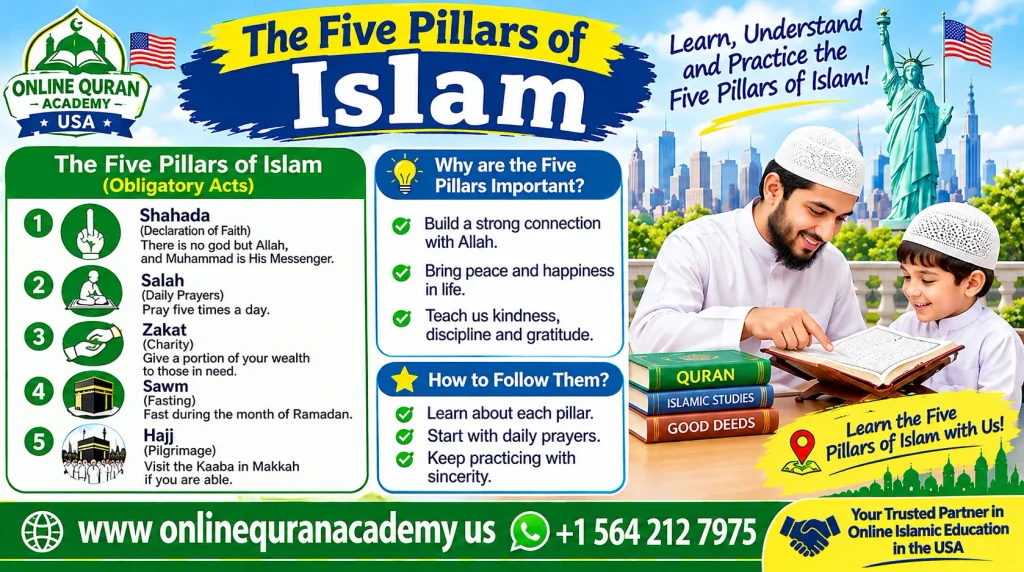
Islam is a way of life built on faith, worship, compassion, and responsibility. The Five Pillars of Islam are the foundation of Muslim life, guiding believers in their relationship with Allah, their responsibilities toward other people, and their daily actions. Whether you are a new Muslim, a parent teaching Islamic values to your children, or someone looking to understand the fundamentals of Islam, learning about the five pillars is an essential starting point.
The five pillars are Shahada (declaration of faith), Salah (daily prayer), Zakat (obligatory charity), Sawm (fasting during Ramadan), and Hajj (pilgrimage to Makkah). Each pillar represents an important act of worship and teaches a particular lesson about faith, discipline, gratitude, patience, and unity.
The Prophet Muhammad ﷺ explained their importance in a famous Hadith:
“Islam is built upon five: testifying that there is no god but Allah and that Muhammad is the Messenger of Allah, establishing prayer, paying Zakat, performing Hajj, and fasting Ramadan.” (Sahih al-Bukhari 8; Sahih Muslim 16).
These five foundations are not simply religious activities performed occasionally. They shape a Muslim’s daily routine, character, decisions, and relationship with the wider community.
In this comprehensive guide, we will explore the Five Pillars of Islam, their meanings, Quranic foundations, practical requirements, spiritual benefits, and how Muslim families can teach them to children.
What Are the Five Pillars of Islam?
The Five Pillars of Islam are five fundamental acts of worship that form the practical foundation of the Islamic faith. The Arabic term for these foundations is Arkan al-Islam.
The five pillars are:
- Shahada: Sincerely declaring that there is no god worthy of worship except Allah and that Muhammad ﷺ is His Messenger.
- Salah: Performing the five obligatory daily prayers.
- Zakat: Giving obligatory charity to eligible recipients when the relevant conditions are met.
- Sawm: Fasting during the month of Ramadan.
- Hajj: Performing the pilgrimage to Makkah at least once in a lifetime when physically and financially able.
Think of Islam as a strong building. Its pillars provide the foundation that supports the structure. Similarly, these acts of worship help Muslims maintain their faith and put Islamic teachings into practice.
Each pillar connects a different aspect of human life with worship. Shahada represents faith and belief, Salah establishes a daily connection with Allah, Zakat purifies wealth and encourages generosity, Sawm develops self-control, and Hajj demonstrates unity and submission.
Why Are There Five Pillars of Islam?
The five pillars were identified by Prophet Muhammad ﷺ as the fundamental practices upon which Islam is built.
They provide Muslims with a practical framework for worship and responsibility. Rather than allowing faith to remain only an idea or personal feeling, the pillars encourage believers to demonstrate their faith through meaningful actions.
They also connect individual worship with community welfare. Prayer brings people together, Zakat supports vulnerable members of society, fasting encourages empathy, and Hajj unites Muslims from different countries and backgrounds.
1. Shahada: The First Pillar of Islam
What Is Shahada in Islam?
Shahada is the Islamic declaration of faith and the first of the Five Pillars of Islam. The word Shahada means testimony or witnessing.
Its Arabic wording is:
أَشْهَدُ أَنْ لَا إِلَٰهَ إِلَّا اللَّهُ وَأَشْهَدُ أَنَّ مُحَمَّدًا رَسُولُ اللَّهِ
Transliteration: Ashhadu an la ilaha illallah, wa ashhadu anna Muhammadan rasulullah.
Meaning: I bear witness that there is no god worthy of worship except Allah, and I bear witness that Muhammad is the Messenger of Allah.
This declaration contains two essential beliefs.
First: Belief in the Oneness of Allah (Tawheed).
Muslims believe that Allah is the one true God, the Creator and Sustainer of everything. He has no partner, equal, or rival, and He alone deserves worship.
Second: Belief in the Prophethood of Muhammad ﷺ.
Muslims believe that Prophet Muhammad ﷺ is the final Messenger of Allah. His teachings and example, known as the Sunnah, guide Muslims in worship, personal conduct, and everyday life.
Importance of Shahada in Muslim Life
Shahada is more than a sentence that Muslims memorize. It represents a sincere commitment to believe in Allah and follow His guidance.
It influences how Muslims approach their responsibilities, relationships, decisions, and worship. A person who understands Shahada recognizes that life has a purpose and that actions should reflect faith and accountability.
For someone entering Islam, sincerely accepting the Shahada marks their entry into the Muslim community. New Muslims can continue learning the details of Islamic worship gradually with guidance and support.
Quranic reference: Surah Muhammad (47:19) instructs believers to know that there is no deity worthy of worship except Allah.
How Can Children Learn Shahada?
Parents can introduce Shahada through simple conversations, short Islamic lessons, and everyday examples.
Explain that Muslims worship only Allah and follow the teachings of Prophet Muhammad ﷺ. Encourage children to memorize the declaration with its meaning instead of simply repeating Arabic words.
Learning the Arabic alphabet and pronunciation can also help children understand Islamic expressions more confidently. Parents may explore online Quran learning for children to build a structured foundation.
2. Salah: The Second Pillar of Islam
What Is Salah in Islam?
Salah, also called Salat or Namaz, is the obligatory ritual prayer performed five times each day by Muslims.
It is one of the most important acts of worship in Islam because it provides regular opportunities to remember Allah, seek His guidance, express gratitude, and strengthen faith.
Muslims perform Salah facing the Kaaba in Makkah. This direction is known as the Qiblah.
The five daily prayers are:
| Prayer | Time |
|---|---|
| Fajr | Dawn, before sunrise |
| Dhuhr | After midday, when the prescribed time begins |
| Asr | Afternoon |
| Maghrib | Immediately after sunset |
| Isha | Night |
The exact prayer times change according to location and season.
Why Are the Five Daily Prayers Important?
Salah helps Muslims organize their day around the remembrance of Allah. Instead of allowing daily responsibilities to become the only priority, prayer reminds believers of their spiritual purpose.
The Quran states:
“Indeed, prayer prohibits immorality and wrongdoing.” (Surah Al-Ankabut 29:45).
This verse highlights how prayer should influence a person’s behavior beyond the prayer mat.
Some important benefits of Salah include:
- Spiritual connection: It strengthens the relationship between a believer and Allah.
- Discipline: Regular prayer develops consistency and time management.
- Peace of mind: Prayer provides opportunities for reflection and remembrance.
- Humility: Bowing and prostrating remind Muslims of their dependence on Allah.
- Unity: Muslims around the world face the same direction and perform the same fundamental act of worship.
How to Perform Salah Correctly
A Muslim prepares for prayer by ensuring cleanliness, performing Wudu when required, wearing appropriate clothing, and facing the Qiblah.
The prayer includes standing, recitation from the Quran, bowing (Ruku), prostration (Sujood), and sitting.
The number of obligatory Rak’ahs varies according to the prayer:
- Fajr: 2 obligatory Rak’ahs.
- Dhuhr: 4 obligatory Rak’ahs.
- Asr: 4 obligatory Rak’ahs.
- Maghrib: 3 obligatory Rak’ahs.
- Isha: 4 obligatory Rak’ahs.
Muslims should learn the correct words, movements, and conditions of Salah from reliable Islamic instruction.
For beginners, learning Arabic letters and Quranic pronunciation is particularly helpful. You can explore the Quran recitation and Tajweed courses offered by Online Quran Academy.
3. Zakat: The Third Pillar of Islam
What Is Zakat in Islam?
Zakat is the obligatory form of charity that eligible Muslims give from qualifying wealth to specified categories of recipients.
The word Zakat carries meanings associated with purification, growth, and blessing.
Unlike ordinary voluntary donations, Zakat is a religious obligation that applies when specific financial conditions are fulfilled.
It reminds Muslims that wealth is a trust from Allah and that financial responsibility includes caring for people who are struggling.
How Much Zakat Do Muslims Pay?
A commonly applicable Zakat rate is 2.5% of qualifying wealth held for one lunar year after meeting the relevant Nisab threshold.
For example, if someone has $10,000 in qualifying Zakatable wealth and all applicable conditions are satisfied, the calculation would be:
$10,000 × 2.5% = $250.
However, Zakat calculations are not always as simple as applying 2.5% to every asset or income source.
Factors may include:
- Cash and bank savings.
- Gold and silver.
- Certain investments and business assets.
- Outstanding debts and financial liabilities.
- The Nisab threshold.
- The lunar-year requirement (Hawl), where applicable.
Different schools of Islamic jurisprudence may differ on particular calculation details. Muslims should consult a qualified scholar or reliable Zakat calculator for their circumstances.
What Is Nisab in Zakat?
Nisab is the minimum qualifying level of wealth that determines whether a person may become liable to pay Zakat.
Traditional Nisab calculations are based on the value of gold or silver. The monetary equivalent changes with market prices.
For this reason, Muslims should check current gold and silver values rather than relying on an outdated fixed dollar amount.
Who Can Receive Zakat?
The Quran identifies eight categories of eligible Zakat recipients in Surah At-Tawbah (9:60):
- The poor (Al-Fuqara).
- The needy (Al-Masakin).
- Those employed to administer Zakat.
- Those whose hearts are to be reconciled.
- People in bondage or qualifying emancipation arrangements.
- Those burdened by eligible debts.
- In the cause of Allah.
- Stranded travelers in need.
These categories demonstrate that Zakat is intended to address genuine financial and social needs.
Zakat vs. Sadaqah: What Is the Difference?
Although both support charitable giving, they are not identical.
Zakat is an obligatory act of worship for eligible Muslims who meet the relevant conditions.
Sadaqah is voluntary charity. It can be given at any time, in any amount, and may include money, food, assistance, kindness, or other beneficial actions.
Zakat teaches financial responsibility, while Sadaqah encourages Muslims to maintain generosity throughout their lives.
4. Sawm: The Fourth Pillar of Islam
What Is Sawm in Islam?
Sawm means fasting, and it is the fourth of the Five Pillars of Islam.
Muslims who are obligated to fast abstain from food, drink, and other actions that invalidate the fast from true dawn (Fajr) until sunset during Ramadan.
Ramadan is the ninth month of the Islamic lunar calendar. It is a special period dedicated to worship, reflection, patience, charity, and spiritual improvement.
Fasting is not simply about avoiding meals. It is also about controlling one’s behavior, avoiding dishonesty, developing patience, and becoming more conscious of Allah.
What Does the Quran Say About Fasting?
Allah says in Surah Al-Baqarah (2:183):
“O you who have believed, decreed upon you is fasting as it was decreed upon those before you that you may become righteous.”
This verse explains an important purpose of fasting: developing Taqwa, or consciousness and awareness of Allah.
Important Practices During Ramadan
Muslims observe several important practices during Ramadan.
Suhoor: The pre-dawn meal eaten before the fasting period begins.
Iftar: The meal used to break the fast at sunset.
Quran recitation: Many Muslims increase their Quran reading during Ramadan.
Taraweeh: Special voluntary night prayers commonly performed during Ramadan.
Charity: Muslims often increase Zakat and voluntary charitable giving during this month.
Dua: Believers make supplications and ask Allah for forgiveness, guidance, and blessings.
Who Is Exempt from Fasting in Ramadan?
Islam recognizes that people may face circumstances in which fasting is difficult or harmful.
Depending on the circumstances and relevant Islamic rulings, concessions may apply to:
- People who are ill.
- Travelers.
- Pregnant or breastfeeding women.
- Women experiencing menstruation or postnatal bleeding.
- Elderly people who cannot reasonably fast.
- People with certain long-term medical conditions.
The way missed fasts are addressed depends on the reason and individual circumstances. Some people make up missed days later (Qada), while qualifying individuals may owe Fidya. Some circumstances involve different rulings.
A qualified scholar should be consulted for personal situations, particularly when medical conditions are involved.
Benefits of Fasting in Islam
Fasting offers spiritual and social benefits.
It teaches patience by requiring Muslims to control physical desires during daylight hours. It develops empathy by helping people appreciate the difficulties faced by those who experience hunger.
It also encourages gratitude. When Muslims break their fast, ordinary food and water become reminders of Allah’s blessings.
Ramadan strengthens family relationships through shared meals, prayer, Quran recitation, and charitable activities. Why Parents Trust Our Online Quran Academy
5. Hajj: The Fifth Pillar of Islam
What Is Hajj in Islam?
Hajj is the annual pilgrimage to the holy city of Makkah in Saudi Arabia.
It is the fifth pillar of Islam and an obligation once in a lifetime for Muslims who are physically and financially capable of completing the journey.
Hajj takes place during specific days of Dhul-Hijjah, the twelfth month of the Islamic calendar.
Muslims travel from different countries and communities to worship Allah together. The pilgrimage represents equality, humility, unity, and submission to the Creator.
What Are the Main Steps of Hajj?
Hajj consists of several important rites performed according to prescribed times and procedures.
1. Ihram
Ihram is the sacred state entered before beginning the pilgrimage. Pilgrims observe specific restrictions and intentions. Men generally wear two simple unstitched white cloths, while women wear modest clothing that meets Islamic requirements.
2. Tawaf
Pilgrims perform Tawaf by circling the Kaaba seven times in an anticlockwise direction.
3. Sa’i
Sa’i involves walking seven circuits between the hills of Safa and Marwah, remembering the story of Hajar (AS) and her search for water for her son Ismail (AS).
4. Standing at Arafat
The Day of Arafah is a central part of Hajj. Pilgrims gather at the plain of Arafat for supplication, remembrance, and seeking forgiveness from Allah.
5. Muzdalifah
Pilgrims travel to Muzdalifah after leaving Arafat, where they spend part of the night and prepare for the next rites.
6. Stoning at Jamarat
Pilgrims perform the prescribed stoning ritual at the Jamarat, symbolizing rejection of temptation and obedience to Allah.
7. Sacrifice and Completion
Animal sacrifice is associated with particular Hajj rites and the days of Eid al-Adha. Pilgrims complete the remaining prescribed rites, including the required shaving or shortening of hair and farewell Tawaf where applicable.
The precise sequence and requirements differ depending on the type of Hajj and relevant jurisprudential rulings.
Why Is Hajj Important in Islam?
Hajj brings Muslims together regardless of nationality, wealth, ethnicity, or social position.
People stand together in worship, dressed simply and focused on pleasing Allah.
The pilgrimage also reminds Muslims of Prophet Ibrahim (AS), Prophet Ismail (AS), and Hajar (AS), whose devotion and obedience are deeply connected with the history of the Kaaba.
Hajj teaches humility, patience, sacrifice, unity, and spiritual renewal.
Why Are the Five Pillars of Islam Important?
The Five Pillars of Islam work together to build a balanced Muslim life.
Each pillar develops a different aspect of faith and character.
1. They Strengthen Faith in Allah
Shahada establishes the foundation of belief and reminds Muslims that worship belongs to Allah alone.
2. They Develop Discipline and Responsibility
Salah establishes a consistent daily routine, while Sawm teaches self-control and patience.
3. They Encourage Generosity and Compassion
Zakat reminds Muslims that wealth should benefit society and that vulnerable people have rights that must be respected.
4. They Unite Muslims Worldwide
Muslims share the same foundational acts of worship regardless of their language, nationality, or culture.
5. They Encourage Spiritual Growth
Every pillar provides an opportunity to improve one’s relationship with Allah and develop stronger moral character.
Five Pillars of Islam vs. Six Articles of Faith
An important question for beginners is whether the Five Pillars and Six Articles of Faith mean the same thing.
They are related, but they describe different dimensions of Islam.
The Five Pillars focus on fundamental acts of worship, while the Six Articles of Faith describe essential Islamic beliefs.
The six articles are:
- Belief in Allah.
- Belief in His angels.
- Belief in His revealed books.
- Belief in His messengers.
- Belief in the Last Day.
- Belief in divine decree (Qadr), both its good and what people perceive as difficult.
The famous Hadith of Jibril (Gabriel), recorded in Sahih Muslim, explains the concepts of Islam, Iman, and Ihsan.
In simple terms, the Five Pillars describe important practices of Islam, while the Six Articles explain what Muslims believe.
Both are essential to understanding the broader Islamic faith.
How Can Parents Teach the Five Pillars of Islam to Children?
Children often learn religious values more effectively through simple explanations, repetition, and positive examples.
Parents do not need to teach everything in one lesson. Instead, they can introduce each pillar gradually and connect it with everyday family activities.
Practical Ways to Teach Children the Five Pillars of Islam
1. Teach One Pillar at a Time
Introduce Shahada first, then gradually explain Salah, Zakat, Sawm, and Hajj.
2. Use Stories and Visual Learning
Children can learn about Prophet Ibrahim (AS), Hajar (AS), and the significance of Makkah through age-appropriate stories and illustrations.
3. Make Salah a Family Activity
Invite children to stand beside parents during prayer and learn the movements gradually.
4. Encourage Giving
Create a small charity box where children can save money to help people in need.
5. Create a Ramadan Learning Routine
Use a Ramadan calendar, short Quran lessons, and family discussions to explain fasting and good manners.
6. Answer Questions Patiently
Children may ask the same question many times. Give clear answers without making religious learning feel frightening or overwhelming.
Parents who want structured instruction can explore Quran classes and Islamic learning programs for children and adults.
How Can New Muslims Learn and Practice the Five Pillars?
Becoming Muslim is the beginning of a lifelong learning journey. New Muslims should not feel that they must understand every detail of Islamic practice immediately.
A practical learning approach includes:
- Understanding the meaning of Shahada.
- Learning the essential conditions and movements of Salah.
- Studying the basic rules of Zakat.
- Preparing for Ramadan and understanding fasting requirements.
- Learning about Hajj and its eligibility conditions.
- Reading the Quran with translation and reliable explanations.
- Seeking guidance from knowledgeable and trustworthy teachers.
Learning Quran recitation can also help new Muslims become more comfortable with the Arabic words used in prayer.
Online Quran Academy offers Quran reading, Tajweed, memorization, translation, and Tafseer courses for learners at different levels.
The goal should be steady progress, accurate learning, and a stronger connection with Islamic teachings.
Frequently Asked Questions About the Five Pillars of Islam
1. What are the five pillars of Islam in order?
The five pillars are Shahada (declaration of faith), Salah (five daily prayers), Zakat (obligatory charity), Sawm (fasting during Ramadan), and Hajj (pilgrimage to Makkah).
2. Why are the five pillars of Islam important?
They provide the practical foundation of Muslim life. They strengthen faith, establish regular worship, encourage generosity, develop patience, and unite Muslims worldwide.
3. What is the first pillar of Islam?
The first pillar is Shahada, the sincere declaration that there is no god worthy of worship except Allah and that Muhammad ﷺ is His Messenger.
4. How many times do Muslims pray each day?
Muslims are required to perform five obligatory daily prayers: Fajr, Dhuhr, Asr, Maghrib, and Isha.
5. How much Zakat do Muslims have to pay?
The commonly applicable rate is 2.5% of qualifying Zakatable wealth, subject to the relevant Nisab and other conditions. Not every type of income or asset is automatically treated in the same way.
6. Is fasting in Ramadan compulsory for every Muslim?
Fasting is obligatory for Muslims who meet the relevant conditions. Islam provides concessions for certain circumstances, including illness, travel, menstruation, and other qualifying situations.
7. Can children perform the five pillars of Islam?
Children can learn and practise age-appropriate aspects of the pillars. The full religious obligations become applicable when the relevant conditions of Islamic accountability are met, including puberty.
8. How many times must a Muslim perform Hajj?
Hajj is obligatory once in a lifetime for Muslims who are physically and financially able to undertake it.
9. What is the difference between Islam and Iman?
Islam generally refers to submission to Allah and includes the fundamental practices of the religion. Iman refers to faith and the essential beliefs a Muslim holds. Both are closely connected.
10. Are the Five Pillars of Islam mentioned in the Quran?
The Quran establishes and discusses the foundations and obligations associated with the pillars, including prayer, Zakat, fasting, pilgrimage, and belief in Allah. The famous Hadith of Ibn Umar in Sahih al-Bukhari and Sahih Muslim explicitly identifies the five pillars together.
11. What happens if someone cannot afford Hajj?
A Muslim who does not meet the financial or physical ability requirements is not obligated to undertake Hajj until the relevant conditions are fulfilled.
12. How can I teach my child the Five Pillars of Islam at home?
Start with simple explanations, short lessons, Islamic stories, family prayers, charity activities, and Ramadan routines. Consistent encouragement and good parental examples make learning easier.
Conclusion: Building a Strong Muslim Life Through the Five Pillars of Islam
The Five Pillars of Islam provide a practical foundation for a Muslim’s spiritual and everyday life. Shahada strengthens belief in Allah, Salah establishes a daily connection with Him, Zakat develops generosity, Sawm teaches patience and self-control, and Hajj demonstrates unity and devotion.
Together, these pillars remind Muslims that faith is not limited to words or occasional acts of worship. It should influence character, decisions, relationships, and responsibilities toward others.
For children, new Muslims, and adults who want to strengthen their understanding, learning these foundations is an important step toward a meaningful Islamic life.
At Online Quran Academy, we believe that authentic Islamic education should be accessible to learners of every age. Our online Quran courses include Quran reading, Tajweed, memorization, translation, and Tafseer, helping students build a stronger foundation in Quranic learning.
Begin your journey of Islamic learning today and take meaningful steps toward understanding, practising, and living the teachings of Islam.
