 Skip to content
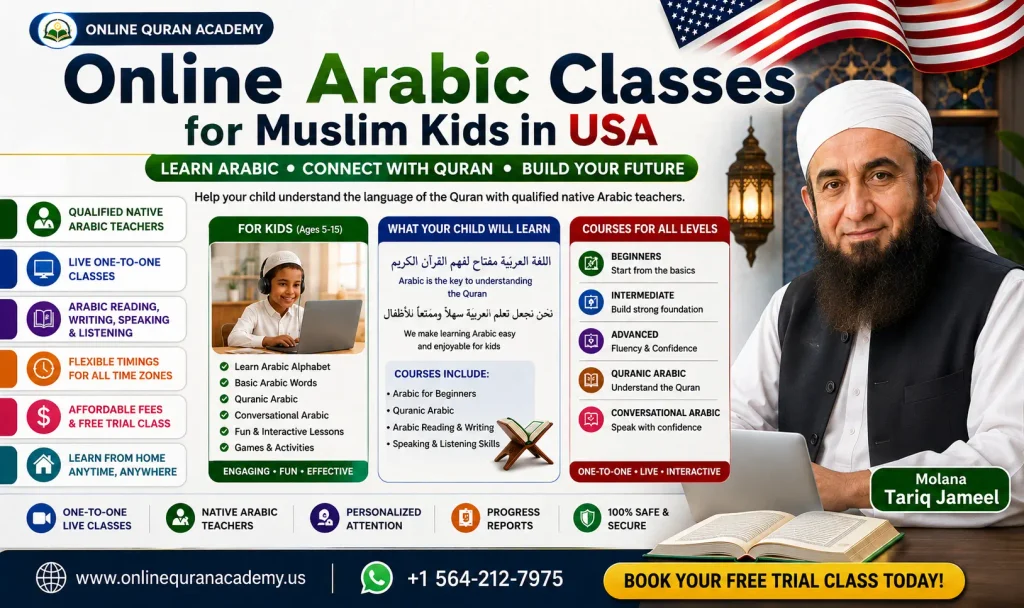
Online Arabic classes for Muslim kids in the USA work best when they’re live, one-on-one or small-group, taught by a tutor trained specifically for children, and built around a clear track — conversational Arabic, Quranic Arabic, or both. Group recorded courses are cheaper but rarely hold a child’s attention past week three. The right fit depends on your child’s age and whether your goal is language fluency, Quran reading, or both.
That’s the short version. Here’s the long one — including the parts most sites selling these classes don’t want to slow down and explain.
Online Arabic Classes for Muslim Kids in the USA, Online Quran Classes, or Both? Get This Straight First
Parents searching for “online Arabic classes for Muslim kids” are usually looking for one of three different things, and a lot of platforms blur them together on purpose because it’s easier to sell one bundled program than to ask what you actually need.
Modern Standard Arabic (MSA) or conversational Arabic teaches the language the way you’d teach French or Spanish — vocabulary, grammar, reading, writing, speaking. This is what your child needs if the goal is fluency: talking to grandparents, reading a newspaper, eventually studying in Arabic.
Online Arabic Classes for Muslim Kids in the USA is narrower. It focuses on the vocabulary and grammar patterns that show up in the Quran specifically, so a child can start understanding what they’re reciting instead of just sounding it out. It overlaps with MSA but isn’t the same course.
Tajweed and Noorani Qaida aren’t Arabic language classes at all — they’re pronunciation and recitation training. Noorani Qaida teaches the alphabet, harakat (vowel marks), and basic sound combinations, usually starting around age four. It’s generally recommended for children aged four and above, and with three to four classes a week it can typically be finished in two to three months. Tajweed comes after that and refines how the letters are actually pronounced and joined.
If a website advertises “Arabic classes” but every testimonial and every course description is really about Quran memorization, that’s a Online Quran Academy wearing an Arabic-class headline for SEO. Not necessarily a problem — but know what you’re signing up for before the free trial call.
What Every Program Out There Already Offers
Skim the top handful of results for this search and you’ll notice they all say roughly the same things: live one-on-one sessions with native, certified tutors; flexible scheduling built around US time zones; a free trial class; safety and “child-friendly” platforms; and some blend of Quran, Tajweed, and Islamic studies alongside the Arabic itself. Online Islamic learning platforms tend to pitch flexibility, accessibility, age-appropriate tracks, and consistency as their core selling points to busy families.
That’s the baseline. It’s not wrong, it’s just not enough to actually choose between programs — every single one of them claims it.
What almost none of them tell you: how to evaluate a tutor before you commit past the free trial, what a female Quran tutor request actually guarantees, how pricing tends to be structured, or what to do when your seven-year-old starts dreading Tuesday’s class. That’s where this guide is going to be more useful than another “why online learning matters” page.
Live Beats Recorded, and It’s Not Close
Skip the recorded-video courses for anything before your child hits their teens. A ten-year-old alone with a screen and a playback button will pause it, get distracted, or click away — you know this already if you’ve handed a tablet to a kid mid-lesson.
Live, one-on-one instruction gives a tutor the ability to notice when a child is bored, confused, or just tired, and adjust in real time. It also creates accountability that a video simply can’t: someone is waiting on the other end of the call.
Small live groups (two to four kids, similar age and level) can work too, and they’re usually cheaper per seat than one-on-one. But group format only holds up if the kids are close in level — otherwise one child dominates the session and another checks out.
How to Actually Vet a Tutor During the Free Trial
Nearly every program offers a free trial. Almost no parent uses it correctly. Most treat it as a courtesy demo and just watch. Use it as an interview instead.
Ask the tutor directly what curriculum they follow and whether they can show you a sample lesson plan for your child’s age — not the sales page, an actual plan. Ask how they handle a child who’s shy on camera, since a good percentage of kids freeze up in the first few sessions and a tutor who’s never dealt with that is a red flag. Ask what happens if your child misses a week: is there a makeup policy, or does it just vanish?
Watch how the tutor talks *to* your child during the trial, not just to you. Online Quran tutors who spends the whole trial pitching you the program instead of engaging your kid is telling you something about how the paid sessions will go.
And ask about qualifications specifically — not just “certified,” which means nothing on its own, but what the certification actually is. Some programs list tutors with Alim or Alima degrees from named religious institutes, which is a more concrete credential than a generic “certified” badge. If a site can’t tell you where a tutor studied, that’s worth noting.
Female Tutors and Classes for Girls
This search term comes up constantly, and for good reason — plenty of Muslim families specifically want a female tutor for their daughters, or for themselves as adult learners, and plenty of programs mention “female tutors available” without saying much else.
Here’s what to actually ask: is the female tutor a standing option you can request from day one, or an add-on that depends on availability that week? Some platforms can genuinely guarantee it because they staff separately for it; others will tell you “usually” or “we’ll try,” which is a different promise entirely. If this matters to your family — and for many it’s non-negotiable — get a straight yes or no before you pay for anything beyond the trial.
It’s also worth asking whether the female-tutor option applies across all their offerings (Arabic, Quran, Tajweed, Islamic studies) or only to one track. Some academies staff it fully for kids’ classes but not for adult conversational Arabic, or the reverse.
What Age Should a Child Start?
Younger than most parents assume, if the entry point is right.
For Arabic letters, sounds, and Noorani Qaida, around age four is a common starting point — the material at that stage is short, repetitive, and built for short attention spans, not a scaled-down adult curriculum.
For conversational Arabic aimed at fluency, five or six tends to work better, once a child already has basic literacy in their first language to lean on.
For Quranic Arabic specifically — understanding meaning, not just reciting — most programs push this later, once a child can already read Arabic script comfortably. Trying to teach meaning before a child can decode the script reliably usually backfires; they end up memorizing translations by rote instead of connecting them to the words.
None of this is a hard rule. Some four-year-olds sit still for twenty-five minutes without blinking. Some seven-year-olds can’t. The starting age matters less than whether the program actually assesses your specific kid before slotting them into a track.
Time Zones and Scheduling, for Real This Time
This sounds like a non-issue until you’re trying to book a 7 p.m. class for a child on the East Coast with a tutor who’s also serving families in Los Angeles and Seattle at the same hour.
Reputable programs schedule around the full range of US time zones — Eastern, Central, Mountain, and Pacific, plus Alaska and Hawaii where relevant — and let you pick morning, evening, or weekend slots. If a platform only offers a narrow evening window, ask directly whether that’s because of tutor availability or because they’re really only set up for one region.
Weekly consistency matters more than session length. A twenty-five-minute class twice a week, same days, same time, beats a single forty-five-minute session that gets rescheduled around soccer practice and khutbahs.
What This Actually Costs
Pricing isn’t something most of these sites put on the page — you’ll find “cost-effective” and “affordable” a lot, and an actual number almost never. Online Quran Classes Fee in USA fill in real per-session or per-month ranges you’ve confirmed, since none are being invented here.
What’s worth knowing without a specific number: one-on-one live tutoring generally costs more per session than small-group classes, monthly subscriptions tend to be cheaper per session than pay-as-you-go, and most platforms front-load the free trial specifically because month one is when families drop out — so a program confident in its retention will make it easy to pause or cancel, not just to sign up.
If a platform pressures you to commit to a long-term package before the free trial has even ended, that’s a sales tactic, not a curriculum decision. Walk away or at least push back.
Also worth checking: does the price change once your child is enrolled — a “beginner rate” that quietly jumps once they move past Noorani Qaida into Quran reading or Tajweed? Some programs structure pricing by level rather than a flat monthly rate, which isn’t dishonest on its own, but it should be disclosed before you commit, not discovered on an invoice three months in. Ask for the full pricing structure across levels up front, even the levels your child hasn’t reached yet.
And ask what’s included versus billed separately — workbooks, digital materials, progress reports, a certificate at course completion. Some of these are bundled; some show up as add-ons after the fact.
What a Good Trial Session Actually Looks Like
Picture two trial sessions side by side.
In the first, the tutor spends five minutes making small talk with your seven-year-old, asks him to point to letters on a shared screen, laughs when he gets one wrong, moves on without dwelling on it, and ends with a small win — a word he can now read that he couldn’t twenty minutes earlier. Then the tutor spends two minutes with you, the parent, explaining specifically what they noticed and what they’d focus on next.
In the second, the tutor reads through a slide deck at your child, asks yes/no questions that don’t require him to actually produce language, and finishes early because “that’s usually how long trials run.” Then you get a follow-up email pushing the annual plan.
Both of these happen constantly across this industry. The difference isn’t visible from a homepage — it’s only visible once you’re in the trial, which is exactly why the trial should be treated as an evaluation, not a formality you sit through to unlock the paid sessions.
Why Kids Quit — And How to Keep Them From Quitting
Screen fatigue is real, and it’s usually not about Arabic. It’s about a child sitting through six hours of school on a screen and then being asked to do one more thing on the same device at 6 p.m.
Shorter, more frequent sessions beat longer, less frequent ones for kids under ten. Twenty minutes, three times a week, holds attention better than forty-five minutes once a week — even though it’s the same total time.
Games and interactive elements aren’t fluff for younger kids; they’re doing real work. Programs that build actual games around Arabic letters and Quran knowledge are responding to something true about how young children learn language — through play, not worksheets. If every session for a six-year-old is a straight recitation drill, expect resistance by week four.
Involve siblings or a parent in short bursts if a child is especially resistant to one-on-one screen time with a stranger, even a kind one. Some programs will let a parent sit in on early sessions; ask if that’s allowed rather than assuming it isn’t.
And talk to your kid about *why* — not as a lecture, just plainly. Kids pick up on whether a class is “something Mom and Dad care about” versus “something imposed on me for no stated reason.” Framing Arabic as connected to identity, culture, and understanding their own faith directly tends to land better with kids than framing it purely as an academic requirement.
Safety: The Part Nobody’s Landing Page Actually Answers
Every site in this space says “safe platform for kids.” Almost none say what that means in practice, and it’s worth pushing on before you hand a tutor recurring video access to your child.
Ask whether sessions are recorded and, if so, who can access the recordings and for how long they’re kept. This matters more for younger children than parents usually consider going in.
Ask whether a parent or guardian is required to be present, allowed to be present, or actively discouraged from sitting in. Programs vary a lot here, and the honest ones will tell you plainly rather than dodging the question.
Ask what background vetting the platform runs on tutors before they’re assigned to work with children — not the marketing language, the actual process. If the answer is vague or the person on the sales call has to “check and get back to you,” that’s useful information on its own.
Ask what the platform’s tutor-swap policy is if your child isn’t comfortable with the assigned teacher after a session or two. A program that locks you into one specific tutor with no reassignment option is a bigger commitment than most families realize until it’s already a problem.
None of this is meant to make online Arabic classes sound risky — for the overwhelming majority of families, it’s a straightforward and safe way to learn. It’s meant to make clear that “safe platform” is a claim, not a guarantee, and claims are worth a follow-up question.
Group Class vs. One-on-One: The Actual Trade-Off
Group classes cost less and give kids peer interaction, which some children genuinely need to stay motivated — nobody wants to be the only one raising their hand on a video call.
One-on-one gets more done per minute. A shy kid who won’t speak up in a group of four will often talk freely alone with a patient tutor.
The honest answer: if your child is naturally social and slightly reluctant about Arabic specifically, try a small group first. If your child needs individual pacing — moving faster in some areas, slower in others — pay for one-on-one even if it costs more. Don’t let price alone decide this; it’s a bigger deal for outcomes than most families treat it as.
Quran Academy vs. Standalone Arabic Tutor — Which One Do You Need?
An “Online Quran Academy USA” and an “online Arabic class” aren’t interchangeable, even though most USA-based platforms now offer both under one roof.
A Quran academy is built around Noorani Qaida, Online Quran Tajweed, and Online Quran Memorization (hifz), with Arabic language taught only as much as it supports recitation and comprehension. If your priority is your child reciting correctly and eventually memorizing surahs, this is the more direct route, and it’s what most of the platforms ranking for “Online Quran Academy in USA” and “Online Quran Classes for kids in United States” are actually optimized for.
A standalone Arabic tutor — sometimes advertised separately from the Quran-focused sites — teaches the language as a language: grammar, vocabulary, conversation, reading comprehension across non-religious texts too. Fewer platforms do this well for children specifically, because the market and the demand skew heavily toward Quran-first families.
Most families end up wanting both eventually. The practical order that tends to work: start with letters and Noorani Qaida (Quran-track), layer in basic conversational vocabulary once reading is solid, then let Quranic Arabic comprehension follow once the child isn’t struggling to decode the script anymore. Trying to run all three simultaneously from day one is how kids end up overwhelmed and parents end up switching platforms three times in a year.
If a single academy claims to do all three equally well from day one for a five-year-old, ask exactly how the weekly session is split. A vague answer means it probably isn’t split at all — it’s one generic curriculum with three labels on it.
Should the Whole Family Learn Together?
A fair number of the parents searching “online Arabic classes for kids in USA” are also, quietly, searching “online Arabic classes for adults” for themselves — often because they want to keep up with what their child is learning, or because they never got the chance growing up.
This is worth doing deliberately rather than as an afterthought. A parent who’s also taking classes, even at a slower pace or a different time slot, changes how a child treats the whole thing. It stops being “the thing I have to do” and becomes something the family does. Some platforms run family-oriented courses for adults and working professionals alongside the kids’ track specifically because of this, scheduling parent sessions around work hours the same way they schedule kids’ sessions around school.
It doesn’t have to mean the same class. A separate adult-track conversational Arabic class for a parent, paired with a Quran-and-Noorani-Qaida track for a six-year-old, is a completely reasonable setup — and often cheaper combined than two unrelated subscriptions, since some academies bundle family accounts.
The Mistakes Parents Make Most Often
Signing up for a full year up front before the trial even finished, because the discount looked good. Save the annual plan for after month two, once you know your child will actually show up to class without a fight.
Picking a platform based only on the volume of testimonials on the homepage. Testimonials are curated by definition — of course they’re positive. Ask the platform to connect you with a current parent for a two-minute call instead, and see if they hesitate.
Assuming “Arabic classes” and “Quran classes” are the same purchase, then being surprised three weeks in that there’s almost no actual Arabic-language instruction happening, just recitation drilling. Go back to the distinction at the top of this piece before you enroll, not after.
Treating the tutor’s nationality as a stand-in for teaching skill. A native Arabic speaker isn’t automatically good at teaching a distracted eight-year-old over video call — those are different skills, and plenty of programs conflate them in their marketing because “native speaker” sounds like a stronger credential than it functionally is for a young child’s class.
Not asking what happens after a missed session until after several sessions have already been missed. Get the makeup policy in writing during the trial, not three cancellations deep.
A Short Checklist Before You Pay for Anything
Confirm the tutor’s specific credentials, not just the word “certified.” Confirm whether female tutors are guaranteed or availability-dependent, if that matters to you. Confirm the cancellation and makeup-class policy in writing, not verbally on a sales call. Confirm which track you’re actually buying — Arabic language, Quranic Arabic, Tajweed, or a bundle — because the marketing often blurs these together. And sit in on at least part of the trial session yourself instead of leaving your child alone with a laptop and checking in twenty minutes later.
The Bottom Line
Most of the programs you’ll find searching this term are more alike than different: live tutors, flexible US scheduling, a free trial, some mix of Arabic and Quran content. The differences that actually matter — real credentials, honest scheduling, a straight answer on female tutors, a fair cancellation policy — rarely show up on the landing page. Ask for them directly before you pay past the trial. That single habit will do more for your child’s Arabic than picking the “best-rated” platform on a search results page ever will.Trustpilot Reviews
Frequently Asked Questions
1. What age should my child start online Arabic classes?
Most programs start kids around age four with letters and Noorani Qaida. Conversational Arabic tends to work better from five or six, once a child already has basic literacy in their first language.
2. Are online Arabic classes as effective as in-person classes?
Live, one-on-one online classes can match in-person results for most kids, especially since a tutor can still see and respond to the child in real time. Recorded, self-paced video courses are far less effective for anyone under their teens.
3. What’s the difference between an online Arabic class and an online Quran class?
An Arabic class teaches the language itself — vocabulary, grammar, reading, writing, speaking. A Quran class focuses on recitation, Tajweed, and memorization, with only as much Arabic as needed to support that. Many platforms blend the two, so it’s worth asking which one you’re actually signing up for.
4. Is Quranic Arabic the same as Modern Standard Arabic (MSA)?
No. They overlap but aren’t identical. MSA covers general vocabulary and grammar for everyday communication. Quranic Arabic is narrower, focused on the specific vocabulary and grammar patterns that appear in the Quran.
5. What is Noorani Qaida, and does my child need it first?
Noorani Qaida teaches the Arabic alphabet, vowel marks (harakat), and basic letter combinations. It’s the standard starting point before Quran recitation or Tajweed, usually beginning around age four.
6. Can I request a female tutor for my daughter?
Many platforms offer female tutors, but availability varies — some guarantee it as a standing option, others only “try” depending on scheduling. Ask for a direct yes-or-no answer before enrolling, not a vague assurance.
7. Do online Quran academies in the USA accommodate different time zones?
Reputable ones schedule across Eastern, Central, Mountain, Pacific, and often Alaska/Hawaii time, with morning, evening, and weekend slots. If a platform only offers a narrow window, ask whether that reflects tutor availability or a limited service area.
8. How much do online Arabic or Quran classes for kids cost?
Pricing varies by platform and rarely appears upfront on marketing pages. One-on-one sessions typically cost more per class than small-group sessions, and monthly plans are usually cheaper per session than pay-as-you-go. [YOUR PRICE DATA: insert confirmed ranges here]
9. Should I choose group classes or one-on-one tutoring?
Group classes cost less and add peer interaction, which helps some kids stay motivated. One-on-one moves faster and works better for shy children or kids who need individualized pacing.
10. How long does it take to learn Noorani Qaida?
With three to four classes a week, it’s commonly completed in two to three months, though pacing depends on the individual child.
11. What qualifications should I look for in an online Arabic or Quran tutor?
Look past the word “certified” and ask what the credential actually is — for example, some tutors hold Alim or Alima degrees from named religious institutes. A platform that can’t specify a tutor’s background is worth questioning.
12. Are online Arabic classes safe for kids?
For most families, yes — but “safe platform” is a claim worth verifying. Ask whether sessions are recorded, who can access recordings, what background vetting tutors go through, and whether a parent can sit in on sessions.
13. What happens if my child misses a class?
Policies vary by platform. Confirm the makeup-class and cancellation policy in writing during the free trial, not after several missed sessions.
14. Can parents learn Arabic alongside their kids?
Yes, and it often helps. Many platforms offer separate adult tracks for conversational Arabic, and some families find learning together makes the child more engaged rather than treating class as a solitary chore.
15. How do I make the most of a free trial class?
Treat it as an interview, not a demo. Ask about the tutor’s curriculum, how they handle a shy child, their makeup policy, and their actual qualifications — and watch how they engage your child directly, not just how they pitch you.
16. Why does my child keep losing interest in online Arabic classes?
Screen fatigue is the most common cause, especially after a full school day online. Shorter, more frequent sessions (like 20 minutes, three times a week) tend to hold attention better than one long weekly class.
17. What’s the best class length and frequency for young children?
For kids under ten, shorter and more frequent sessions generally outperform longer, less frequent ones — even at the same total weekly time.
18. Do online Quran classes include Islamic studies too?
Many do, covering areas like Seerah, basic Fiqh, and core practices such as Wudu and Salah alongside recitation. Confirm whether this is bundled into your plan or offered separately.
19. Is a native Arabic-speaking tutor automatically a good teacher for kids?
Not necessarily. Native fluency and the ability to teach a distracted eight-year-old over video call are different skills. Ask about teaching experience with children specifically, not just language background.
20. Can I switch tutors if my child isn’t comfortable with the one assigned?
Ask this before enrolling. Some platforms allow easy tutor reassignment; others lock you into one tutor with limited flexibility, which matters if your child needs time to warm up to someone new.
21. What’s the ideal starting point: Arabic language or Quran recitation?
Most families start with letters and Noorani Qaida, add basic conversational vocabulary once reading is solid, and move into Quranic Arabic comprehension after the child can decode the script comfortably.
22. Do online Arabic classes work for homeschooling families?
Yes, many platforms are flexible enough to fit into a homeschool schedule, and some offer more session frequency during the day compared to after-school-only slots for traditionally schooled kids.
23. How do I know if a program’s “certified tutors” claim is meaningful?
Ask specifically where and how the tutor was certified, or what degree/credential they hold. A vague answer (“certified” with no detail) is a weaker signal than a named institute or degree.
24. Should I sign up for a long-term plan right away?
No — wait until after the first month or two, once you know your child will consistently attend, before committing to an annual plan. Platforms that push long-term commitments before your trial even ends are using a sales tactic, not a curriculum decision.
25. What’s the single most important thing to check before enrolling?
Get clear, direct answers on tutor credentials, cancellation/makeup policy, and — if relevant to your family — guaranteed female tutor availability. These rarely appear on the landing page and matter more than star ratings or testimonials.
Home
Contact Us +1 564 212 7975
