 Skip to content
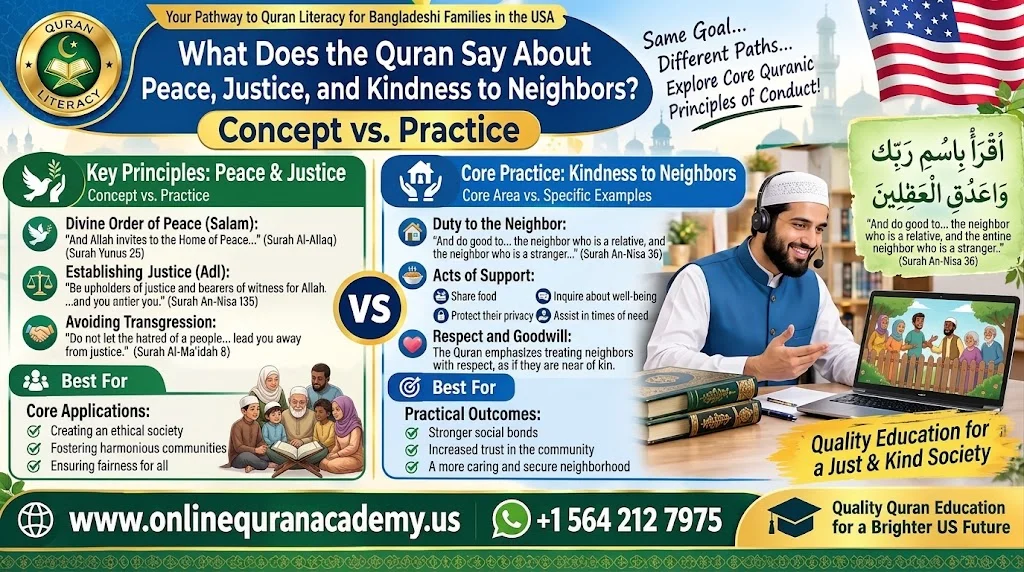
The Quran answers this in three connected moves: it names peace (salam) as the goal, justice (‘adl) as the non-negotiable method for reaching it, and kindness to neighbors as the test of whether a person’s faith is real. Skip any one of the three and the other two collapse — a “peace” without justice is just quiet oppression, and “kindness” that stops at your own front door was never really kindness at all.
The Short Answer
If you only have thirty seconds: what does the Quran say about peace? It commands justice even against your own interests (4:135), names kindness to neighbors — related or not, Muslim or not — as a direct instruction alongside worshipping God (4:36), and roots the entire religion in the word salam, peace. Understanding this properly usually means going beyond a single blog post — a guided Quran teachings about peace in Islam USA session with a real tutor walks through the tafsir behind each of these ayat.
Why “Salam” Is at the Root of Everything Islam Teaches
Islam comes from the same three-letter Arabic root as salam — peace. That’s not a coincidence scholars point to for flavor; it’s the actual etymology, and one of Allah’s own names in the Quran is As-Salam, “The Source of Peace” (Surah Al-Hashr, 59:23).
But here’s where most explainers stop, and where the confusion starts. Peace in the Quran isn’t the absence of conflict. It’s closer to soundness — a heart, a household, a society that isn’t corroding from the inside. Surah 26:89 puts it plainly: what actually benefits a person on the Last Day is coming to God with “a sound heart” (qalb saleem) — the same root again. This is one of the core Quran teachings about peace that gets lost when the verse is quoted without context.
That distinction matters because it’s the piece competitor articles skip. When Muslims greet each other with Assalamu alaikum, they’re not just saying “hi.” They’re making a small promise — you are safe from me — dozens of times a day. Multiply that across a community and you get the Quran’s actual peace project: not a treaty, a habit. Reading these Quran verses about peace and kindness in Arabic, with correct Tajweed, is where the weight of the words really lands — something a translation alone can flatten.
What Does the Quran Say About Justice?
Here’s the verse most Islamic scholars treat as the constitutional core of the whole religion:
“Indeed, Allah orders justice and good conduct and giving to relatives and forbids immorality and bad conduct and oppression.” — Surah An-Nahl, 16:90
Read that again slowly. Justice (‘adl) comes first, before kindness (ihsan), before generosity to family. The order isn’t random — classical commentators, including Ibn Kathir, read it as sequence: be fair first, then be generous. This is the heart of Quran teachings on justice, and it’s a theme that runs through far more of the text than the single neighbor verse everyone quotes.
The Quran pushes this further than most religious texts are willing to go. Surah An-Nisa, 4:135, tells believers to stand firm for justice even as witnesses against themselves, their parents, or their relatives, and even when the wealthy or the poor try to bend the outcome. Anyone searching what does the Quran say about justice expecting a soft, feel-good answer will find something closer to a legal standard — there’s no clause that says “unless it’s inconvenient” or “unless the other party is family.”
And peace and justice aren’t rivals here. Surah Al-Anfal, 8:61, tells believers that if the other side inclines toward peace, they should incline toward it too and trust God with the outcome. This is Quran on peace and justice working as one system: peace is the preference, justice is what makes that preference sustainable instead of naive.
What Does the Quran Say About Kindness to Neighbors?
This is the verse everyone quotes, and for good reason:
“Worship Allah and associate nothing with Him, and do good to parents, kinsfolk, orphans, the needy, the near neighbor, the neighbor farther away, the companion at your side, the traveler, and those whom your right hands possess. Indeed, Allah does not like those who are arrogant and boastful.” — Surah An-Nisa, 4:36
Notice the placement. Kindness to neighbors sits in the same sentence as the command to worship God alone. Anyone looking into what does the Quran say about kindness to neighbors should start here — Ibn Kathir’s commentary distinguishes “the near neighbor” (which may include a relative living close by) from “the neighbor farther away” (a stranger). The Quran doesn’t let you off the hook just because you don’t know the person.
The hadith literature backs this up with more force than most people expect. In Sahih al-Bukhari, the Prophet ﷺ said Angel Jibril kept advising him about neighbors “until I thought he would make them heirs.” Then there’s the line that should stop most people mid-scroll:
“He whose neighbor is not safe from his harm will not enter Paradise.” — Sahih al-Bukhari 6016
Not “will have a lesser reward.” That’s a Paradise-level condition, tied to something as ordinary as whether the person next door feels safe around you. It’s the clearest of all the Quran verses about kindness to others precisely because it removes the option of treating this as a suggestion.
Who Counts as a Neighbor? Islam’s Answer Widens the Circle
Most people assume “neighbor” means the house next door. The Quran and the scholarly tradition built on it define the term far more broadly — and this is where a lot of well-meaning articles quietly narrow the scope without saying so.
Classical scholars generally group neighbors into several overlapping categories: the person physically next to you, the person who is also a relative, the coworker or classmate you sit beside, and — this is the one that gets left out most often — the neighbor who doesn’t share your faith at all. These are the Islamic rights of neighbors in Quran that a lot of casual explainers gloss over.
Abdullah ibn Amr, a companion of the Prophet ﷺ, used to ask his household after every animal was slaughtered: “Have you given some to our Jewish neighbor?” He repeated it twice. He wasn’t asking out of politeness — he was recalling a specific teaching about the weight of that relationship.
How Does Islam Teach Us to Treat Non-Muslim Neighbors?
Directly, and without a loophole. Surah 4:36 doesn’t say “the Muslim near neighbor” — it just says neighbor. Anyone asking how does Islam teach us to treat our neighbors when the neighbor isn’t Muslim will find the scholarship treats it as covering ordinary worldly matters: checking in when they’re sick, helping if something goes wrong at their house, not disturbing them, sharing food.
There is one boundary worth being precise about: kindness in daily matters doesn’t extend to participating in another faith’s worship or endorsing a religious practice a Muslim doesn’t believe in. That’s a different category from ordinary neighborliness, and conflating the two is a common overcorrection. You can bring soup to a sick neighbor and still be clear about who you are — this is the balance covered in most Islamic teachings about neighbors once you get past the surface-level version. Trustpilot Reviews
Quran Teachings About Peace, Justice, and Kindness for Muslim Families in the USA
This is the part almost nobody writing about this topic actually addresses, and it’s where the verses stop being theoretical.
American Muslims are often the “farther neighbor” in the Quran’s own language — living next to people who’ve never met a Muslim before, in apartment buildings, HOA communities, or towns with one mosque and a lot of curiosity. Families looking for Quran teachings for Muslim families in USA won’t find a clause exempting interfaith or first-generation-immigrant situations — if anything, these verses were revealed in a Medinan community that was itself religiously mixed.
Practically, that plays out in small, unglamorous ways: introducing yourself when you move in instead of staying anonymous, speaking up calmly when an HOA or landlord treats a Muslim family unfairly, correcting a misconception about Islam with patience rather than defensiveness. Parents raising kids on this material often start with structured Quran lessons for Muslims in America so the ethics aren’t just talked about at home but studied properly, verse by verse.
Common Mistakes People Make When Reading These Verses
Mistake one: treating peace as passivity. The Quran’s peace isn’t “avoid all conflict.” Surah 4:135 explicitly requires standing up against injustice, including within your own family — one of the Quran teachings about fairness and justice most often misread as its opposite.
Mistake two: treating “neighbor” as only meaning Muslim neighbor. Covered above, but worth repeating because it’s the single most common omission across articles ranking for this topic.
Mistake three: quoting 4:36 without quoting the hadith that gives it teeth. The verse alone can read as a nice sentiment. The hadith about a neighbor not being “safe from your harm” turns it into a Paradise-level standard — one of the Quran teachings about helping others that loses its weight when isolated from the hadith backing it.
Mistake four: separating justice from mercy, as if they compete. Surah 42:40 makes the tradeoff explicit: retaliation is permitted, but pardoning and making peace carries a reward “with God” that goes beyond what strict justice requires. This is where Quran teachings about compassion and mercy and justice actually meet rather than cancel each other out.
A Simple Way to Start Living These Teachings This Week
Pick one neighbor you don’t know well. Not a project, not a campaign — one person. Knock, introduce yourself, and mean it. If there’s a language or cultural gap, bring food; it translates.
[YOUR EXAMPLE: a specific moment from your own community where a small act of neighborliness changed a relationship — insert here if you have one]
That’s the whole method the Quran actually prescribes. Not a program. A habit, repeated until it stops feeling like an act and starts being who you are. Families who want Islamic guidance for Muslims in America on turning verses like these into daily practice usually get more out of one-on-one sessions with a tutor than from reading alone.
FAQs
1. What does the Quran say about peace?
The Quran roots the entire religion in the word salam (peace) and calls God Himself As-Salam (Surah Al-Hashr, 59:23). Peace begins as an inward state — “a sound heart” (26:89) — before it becomes a social one.
2. What does the Quran say about justice?
Surah An-Nahl (16:90) states that Allah commands justice and good conduct and forbids oppression — justice is named first, before kindness or generosity.
3. What does the Quran say about kindness to neighbors?
Surah An-Nisa (4:36) instructs believers to do good to “the near neighbor, the neighbor farther away,” placing it in the same verse as the command to worship God alone.
4. What does the Quran say about good neighbors?
A good neighbor, per the Quran and hadith, is someone whose presence brings safety, not harm — the Prophet ﷺ said a person whose neighbor isn’t safe from their harm will not enter Paradise (Sahih al-Bukhari 6016).
5. What does Islam say about treating neighbors?
Islam treats neighborliness as a test of faith, not etiquette. It applies regardless of religion, ethnicity, or whether the neighbor is a relative or a total stranger.
6. Quran verses about peace and kindness — where do I find them?
Key references include 4:36 (kindness to neighbors), 8:61 (inclining toward peace), 59:23 (Allah as As-Salam), and 42:40 (pardoning as a path to reward).
7. Quran verses about justice — which are most cited?
16:90, 4:135, and 5:8 are the most commonly cited justice verses, each commanding fairness even when it works against self-interest.
8. Quran verses about helping neighbors — is there a specific command?
Yes — 4:36 lists the neighbor alongside orphans, the needy, and travelers as people owed active good treatment, not just tolerance.
9. Quran verses about kindness to others — beyond neighbors?
Surah 42:40 extends kindness into forgiveness, noting that whoever pardons and makes peace has a reward “with God” beyond strict justice.
10. Quran verses about loving your neighbor — does this concept exist in Islam?
Islam frames it less as an emotion and more as an obligation of conduct — safety, generosity, and fairness toward the neighbor are commanded regardless of personal feeling.
11. Islamic teachings on respecting neighbors — what do they include?
Greeting them, not disturbing them with noise or smoke, sharing food when cooking, checking in during illness, and safeguarding their privacy and property.
12. Islamic rights of neighbors in Quran — how many are there?
Scholars don’t fix an exact number, but rights commonly cited include safety from harm, a share of food, assistance in need, and confidentiality about their affairs.
13. How does Islam teach us to treat our neighbors?
As an extension of worship itself — 4:36 places neighbor-kindness directly after the command to worship Allah alone, tying the two together.
14. Quran teachings about helping others — is this limited to Muslims?
No. The rights described for neighbors and the needy in the Quran are not restricted to fellow Muslims.
15. Quran teachings about compassion and mercy — what’s the core idea?
That mercy and justice aren’t opposites — 42:40 shows forgiveness as something that builds on justice rather than replacing it.
16. Quran teachings about peaceful living — what does this look like day to day?
A household and community where people feel safe, disputes are resolved fairly, and neighbors are treated as an extension of family obligation.
17. Quran teachings about fairness and justice — how strict is the standard?
Very strict — 4:135 requires standing firm for justice even as a witness against oneself, one’s parents, or close relatives.
18. Importance of kindness in Islam — why does it matter so much?
Kindness is tied directly to faith itself in hadith literature — indifference to a neighbor’s hunger or safety is treated as a deficiency in belief, not just manners.
19. Importance of justice in Islam — why is it emphasized before mercy?
Because unfair systems make generosity meaningless — 16:90 orders justice first, then good conduct, as sequential steps rather than interchangeable ones.
20. Importance of good neighbors in Islam — is it really a major theme?
Yes. The volume and severity of hadith on this subject (including a Paradise-level warning) shows it’s treated as central, not peripheral.
21. What does the Quran say about peace and justice in Islam in the USA context?
The same commands apply wherever a Muslim lives — American Muslims are called to the same standard of fairness and neighborliness in interfaith, mixed-culture settings as anywhere else.
22. Islamic teachings about peace and justice — how do they relate to each other?
Justice is presented as the method; peace is the outcome. Surah 8:61 shows peace as the preferred path once justice and trust are established.
23. Quran lessons for Muslims in America — where should someone start?
Starting with tafsir of 4:36 and 16:90, ideally with a qualified tutor, gives the clearest foundation before moving into broader themes of justice and neighborliness.
24. Quran teachings for Muslim families in USA — how does this apply practically?
Families are encouraged to introduce themselves to neighbors, correct misconceptions about Islam calmly, and model fairness in disputes — including HOA or landlord conflicts.
25. Islamic values of peace and kindness — are they taught to children?
Yes, typically through short surahs and hadith about neighbors and kindness, introduced early as part of basic Islamic studies.
26. Quran guidance for Muslims in America — does it address living among non-Muslims specifically?
Indirectly but clearly — the “neighbor farther away” in 4:36 has historically been understood to include non-Muslims, and companion narrations (like Abdullah ibn Amr’s Jewish neighbor) reinforce this.
27. Islamic teachings about neighbors — do they cover non-Muslim neighbors too?
Yes. Kindness applies to non-Muslim neighbors in everyday matters, with the one boundary being participation in another faith’s religious worship.
28. Does the Quran say peace means avoiding all conflict?
No — this is a common misreading. 4:135 requires standing against injustice, showing that peace in the Quran isn’t passivity in the face of wrongdoing.
29. What hadith supports the Quran’s teaching on neighbors?
The Bukhari hadith describing Angel Jibril’s repeated advice about neighbors, and the hadith stating a person whose neighbor isn’t safe from their harm won’t enter Paradise, are the two most cited.
30. Can these teachings be studied in more depth online?
Yes — a structured Tafseer course with a qualified tutor walks through verses like 4:36 and 16:90 in their full context, rather than as isolated quotes.
Verdict
Peace, justice, and kindness to neighbors aren’t three separate Quranic themes stitched together for a listicle. They’re one instruction read at three different distances — peace as the goal, justice as the method that gets you there honestly, and the neighbor relationship as the place where you find out whether any of it is real. To study these ayat properly — in Arabic, with Tajweed, alongside the tafsir — a Quran on peace and justice for Neighbours-focused Tafseer course is built for exactly that, and a 3 Days free trial classes is the lowest-friction way to try it.
