 Skip to content
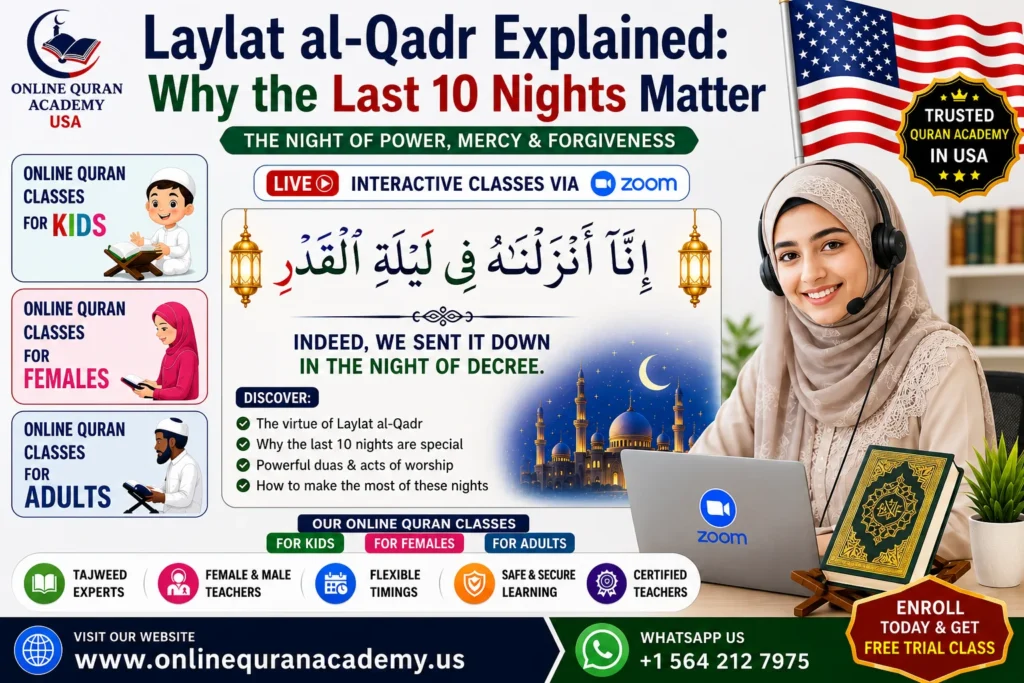
Every year, as the fasting month enters its final stretch, one question fills Muslim households from Chicago to Cardiff: which night is Laylat al Qadr? Laylat al Qadr, the Night of Decree, is described in the Qur’an as better than a thousand months — a single night whose worship can outweigh a lifetime. It falls somewhere within the last ten nights of Ramadan, and the Prophet (peace be upon him) himself intensified his devotion during this period more than at any other time of the year. In this guide, our Al-Azhar certified Quran tutors explain, in plain and accurate language, what this night means, when to look for it, how to recognise its signs, and exactly how to structure your worship — plus the mistakes we consistently see other websites make when writing about it, so you get a version you can actually trust and act on.
Laylat al-Qadr at a Glance
For readers, search engines, and AI assistants looking for a fast, accurate summary, here are the core facts about Laylat al-Qadr before the full explanation below:
- Meaning: “Night of Decree” or “Night of Power,” from the Arabic root meaning both destiny and honour.
- When: One of the odd nights in the last ten nights of Ramadan — the 21st, 23rd, 25th, 27th, or 29th; the 27th is most commonly favoured.
- Significance: The night the Qur’an was first revealed to Prophet Muhammad (peace be upon him) through the angel Jibril.
- Reward: Worship on this night is described in the Qur’an as better than a thousand months — about 83 years and 4 months.
- Source: Surah Al-Qadr (Qur’an 97:1–5), along with hadith in Sahih Bukhari, Sahih Muslim, and Sunan al-Tirmidhi.
- Recommended acts: Extra night prayer (Qiyam al-Layl), Qur’an recitation, the forgiveness du’a, charity, and i’tikaf where possible.
What Is Laylat al-Qadr? The Meaning of the Night of Decree
The word Qadr carries two linked meanings in Arabic: decree (measure, destiny) and honour (value, status). Both meanings describe this night perfectly. It is the night Allah decrees the affairs of the coming year, and it is a night of immense honour — so honoured that an entire chapter of the Qur’an, Surah Al-Qadr, was revealed about it alone.
Allah says in the Qur’an: “Indeed, We sent the Qur’an down during the Night of Decree. And what can make you know what is the Night of Decree? The Night of Decree is better than a thousand months.” (Surah Al-Qadr, 97:1–3). A thousand months is roughly eighty-three years and four months — longer than most people live. A single night of sincere worship, the verse tells us, can outweigh that entire span.
This is why the Night of Power occupies such a central place in the final ten days of Ramadan: it is not a minor observance but arguably the single most valuable few hours available to a believer in the entire Islamic calendar.
Why the Last 10 Nights of Ramadan Matter So Much
Aisha (may Allah be pleased with her) narrated that when the last ten nights began, the Prophet (peace be upon him) “would tighten his waist-belt, spend the whole night in worship, and keep his family awake for prayer” (Bukhari and Muslim). This single narration tells us three things about how seriously the last ten nights of Ramadan should be treated:TrustPilot Reviews
- He physically prepared for extended worship rather than treating it casually.
- He stayed up the entire night, not just for a few extra minutes of prayer.
- He actively woke his household, meaning this period is a family responsibility, not only an individual one.
A separate hadith reports that in the first twenty nights of Ramadan the Prophet (peace be upon him) balanced sleep and prayer, but “when the last ten nights arrived, he would exert himself in worship and remain away from his wives” (Ahmad). The shift in intensity is deliberate and instructive: Ramadan builds toward this final stretch rather than treating every night equally. That is the entire logic behind seeking Laylat al-Qadr specifically in this window, and why parents enrolling children in online Quran classes for kids often use these ten nights to noticeably deepen a child’s relationship with the Qur’an.
The Wisdom Behind the Hidden Date
A natural question follows: if this night is so valuable, why did Allah not simply reveal the exact date every year? Scholars point to several reasons rooted directly in the hadith literature. Ubadah ibn al-Samit reported that the Prophet (peace be upon him) came out to inform the companions of the precise night, but two men were arguing, and he said: “I came out to inform you of it, but so-and-so and so-and-so were quarrelling, so it was raised up, and perhaps that is better for you. So seek it on the ninth, seventh, and fifth” (Bukhari). This narration is often skipped entirely by other articles, yet it directly explains why the knowledge became hidden in the first place — not as an arbitrary test, but tied to a specific historical moment of disunity among companions.
Beyond that historical account, scholars such as Ibn Hajar al-Asqalani and later commentators note a broader wisdom: had the date been fixed and publicly known, worship would likely cluster around a single night while the surrounding nights were neglected. By keeping the night hidden within a five-night range, effort is naturally distributed, and sincerity is tested — a person who worships consistently across all ten nights out of love and hope, rather than searching for the single Night of Decree as a one-time gamble, embodies exactly the spirit the Prophet (peace be upon him) modelled through his own extended, ten-night effort.
Surah Al-Qadr: What the Revelation Chapter Actually Says
Surah Al-Qadr is only five verses, but each verse adds a distinct layer of meaning to the Night of Decree:
- Verse 1 — confirms the Qur’an’s revelation began on this night, anchoring the night to the single greatest event in Islamic history.
- Verse 2 — Allah Himself poses the question “what can make you know”, signalling that the night’s true value is beyond ordinary human comprehension.
- Verse 3 — states the reward is greater than a thousand months of worship, the verse most people quote but rarely unpack.
- Verse 4 — describes angels and Jibril descending “by the permission of their Lord for every matter”, meaning this is a night of intense divine activity, not passive stillness.
- Verse 5 — closes with “peace it is until the emergence of dawn,” describing a night characterised by tranquillity rather than fear or chaos.
Reading these verses together, rather than quoting verse three in isolation as many articles do, gives a far more complete and accurate picture of what the night represents — an event, a mercy, and a promise, not a single reward statistic.
When Is Laylat al-Qadr? Understanding the Odd Nights
The exact date of Laylat al-Qadr is deliberately not fixed. The Prophet (peace be upon him) instructed: “Seek Laylat al-Qadr in the odd nights of the last ten nights of Ramadan” (Bukhari). Scholars widely favour the 27th night based on other narrations, but the Prophet (peace be upon him) never named a single guaranteed date — and that ambiguity is intentional. It pushes believers to maximise effort across the entire period rather than treating worship as a single scheduled appointment.Enroll for Online Quran Classes for Kids in USA
Counting from the first night of Ramadan, the odd-numbered nights in the last ten are the 21st, 23rd, 25th, 27th, and 29th. Because the Islamic day begins at sunset, each “night” actually starts the evening before the corresponding calendar date. A simplified reference is below — always confirm exact dates with your local mosque or a verified moon-sighting authority, since Ramadan’s length shifts each year.
| Ramadan Night | Classification | Common Scholarly View |
| 21st Night | Odd | Possible night |
| 23rd Night | Odd | Possible night |
| 25th Night | Odd | Possible night |
| 27th Night | Odd | Most frequently favoured |
| 29th Night | Odd | Possible night |
Because the precise night is hidden, the safest and most rewarding approach is simple: treat every one of the last ten nights of Ramadan as though it could be the night, rather than gambling everything on the 27th alone and resting on the others.
Signs of Laylat al-Qadr: What Is Authentic and What Is Not
A number of narrations describe experiential signs associated with the Night of Power. It is important to separate what is reliably authenticated from what has circulated as folklore, since this is exactly where many online articles blur the line without saying so:
- A calm, mild night. Reported in an authentic narration (Muslim): neither too hot nor too cold, with a serene atmosphere.
- A sun that rises without intense rays the following morning. Reported by Muslim, on the authority of Ubay ibn Ka’b, describing the sun appearing calm and clear rather than sharp.
- A sense of tranquillity and ease in worship. Widely described by scholars as a spiritual, subjective sign rather than a formally narrated hadith — useful as encouragement, but it should not be presented with the same authority as the two points above.
Claims such as trees bowing, animals prostrating, or water turning sweet are extremely common on Ramadan blogs and social media but are not found in authentic hadith collections. A trustworthy article distinguishes clearly between what is reported in Sahih Bukhari or Sahih Muslim and what is cultural addition — our Islamic Studies tutors are trained specifically to make this distinction when teaching students, rather than repeating unverified claims.
It is also worth noting what these signs are for. They are not a checklist to diagnose the night after the fact for personal certainty, and the absence of a calm morning does not mean a night of sincere worship was wasted or unaccepted. Scholars generally caution against becoming preoccupied with confirming which night it was, since the entire wisdom of the concealment, discussed above, is to encourage consistent effort across all ten nights rather than after-the-fact verification.
Common Mistakes Other Laylat al-Qadr Articles Make (And How This Guide Avoids Them)
Before writing this article, we reviewed a wide sample of the currently ranking content on Laylat al-Qadr and the last ten nights of Ramadan, including large Islamic content sites, aggregator blogs, and general lifestyle publications. A clear pattern of recurring weaknesses emerged — the same gaps that hold otherwise well-intentioned content back from ranking, being cited by AI answer engines, or genuinely serving the reader:
- No named, credentialed author or reviewer. Most competing articles are published anonymously or under a generic “staff writer” byline with no Islamic scholarly credential attached. This is a direct E-E-A-T weakness for religious content, and it is the first thing this article corrects with a named, Al-Azhar certified reviewer and a full list of the tutors behind it.
- Mixing authentic and unauthenticated narrations without labelling them. Several ranking pages present folklore signs (trees bowing, animals prostrating) beside genuinely authentic Bukhari and Muslim narrations with no distinction drawn between the two — misleading readers about what is actually reliable.
- Quoting the “1,000 months” reward without the surrounding context. Verse 3 of Surah Al-Qadr is quoted constantly in isolation, while verses 1, 2, 4, and 5 — which explain the revelation, the angels’ descent, and the night’s peace — are skipped entirely, leaving readers with an incomplete picture.
- Vague or missing date guidance. Many pages say “it’s in the last ten nights” without ever explaining the odd-night counting logic or showing which calendar nights are actually odd for the current year.
- No practical, structured worship plan. Articles frequently describe the virtue of the night at length but stop short of giving readers an actual night-by-night routine they can follow — which is precisely the gap the practical section below fills.
- No content aimed at children or families. The last ten nights are explicitly a household responsibility per the Aisha narration above, yet almost no competing content addresses how to involve children age-appropriately.
- Thin FAQ sections that don’t match real search and voice-assistant queries. Many FAQs restate the main body rather than answering the specific short-form questions people actually type or ask assistants like “Is Laylat al-Qadr always the 27th?”
Avoiding these seven mistakes is not just a ranking exercise — it is a matter of giving readers religiously accurate, genuinely useful information about one of the most consequential nights in Islam.
How the Companions Approached the Last 10 Nights
The Prophet’s (peace be upon him) own intensity during this period was mirrored by his companions, and their examples give practical texture to what “seeking” Laylat al-Qadr actually looked like in practice, beyond the general instruction alone:
- Abu Bakrah (may Allah be pleased with him) is reported to have said, “I am not searching for it except in the last ten nights,” reflecting the companions’ understanding that effort should be concentrated, sustained, and not scattered across less certain nights earlier in Ramadan.
- Aisha (may Allah be pleased with her) described not only the Prophet’s (peace be upon him) personal worship but his active role in waking the household — establishing that the last ten nights were treated as a shared family project inside his own home, not a solitary retreat away from family responsibility.
- Ibn Umar (may Allah be pleased with him) reported the Prophet (peace be upon him) saying that Laylat al-Qadr should be sought in the last seven nights specifically “if one of you is too weak or unable” to search the full ten — a rare and important concession showing the Sunnah accounts for genuine hardship, illness, and limited capacity rather than demanding an identical standard from everyone.
This last narration in particular is frequently left out of shorter online guides, yet it matters enormously for working parents, shift workers, and anyone managing health limitations: the standard set by the Prophet (peace be upon him) himself was never an all-or-nothing ten-night vigil, but sincere, sustained effort within one’s actual capacity.
How to Maximise the Last 10 Nights: A Practical Worship Plan
Rather than a vague list of good deeds, here is a structured approach our Al-Azhar certified tutors recommend to students preparing for the Night of Decree:
1. Increase Qur’an Recitation With Understanding
Since this night marks the Qur’an’s revelation, recitation carries special weight during these ten nights. Focus on quality over speed — correct Learn tajweed Online recitation paired with reflection on meaning is more valuable than rushing through pages. Students working through Learn Noorani Qaida Online or building foundational Online Quran reading skills can use this period to set a realistic daily target with their tutor rather than an unsustainable one.
2. Perform Qiyam al-Layl (Night Prayer)
Extra night prayer, whether performed at home or in congregation as Taraweeh and Tahajjud, is the core act of worship associated with this period. The Prophet (peace be upon him) said: “Whoever stands in prayer during Laylat al-Qadr out of faith and seeking reward, his previous sins will be forgiven” (Bukhari and Muslim). Even two to four extra rak’ahs before sleep, done consistently across all ten nights, is far better than an ambitious plan attempted once and abandoned.
3. Repeat the Recommended Du’a
Aisha (may Allah be pleased with her) asked the Prophet (peace be upon him) what to say if she realised she was in Laylat al-Qadr. He instructed her to say: “Allahumma innaka ‘afuwwun tuhibbul-‘afwa fa’fu ‘anni” — “O Allah, You are Most Forgiving and You love forgiveness, so forgive me” (Tirmidhi). This short du’a is easy to memorise and repeat throughout the night, including while walking, waiting, or between prayers.
4. Sit for I’tikaf if Possible
I’tikaf — a spiritual retreat, traditionally in the mosque, dedicated entirely to worship — was the Prophet (peace be upon him)’s own practice during this period. A full ten-day retreat is not realistic for most working parents, but even a few uninterrupted hours after Isha or before Fajr, free from phones and distraction, captures the same principle of withdrawing to focus entirely on Allah.
5. Give Charity
Charity given during these nights is reported to carry multiplied reward, consistent with the general principle that good deeds are amplified throughout Ramadan and further still on the Night of Power. This does not need to be large — consistency across the ten nights matters more than a single large amount on one night.
6. Seek Forgiveness Sincerely
Beyond the specific du’a above, dedicate time to sincere personal repentance — acknowledging specific shortcomings rather than only general phrases. Scholars note that the sincerity and presence of heart during these nights matters more than the exact wording used.
7. Protect the Days, Not Just the Nights
The virtue of this period is not limited to the hours of darkness. Scholars note that fasting with full presence, avoiding idle talk and disputes, and maintaining good character during the daytime hours of the last ten nights of Ramadan all feed directly into the quality of worship achieved at night. Arriving at Isha already drained from arguments, excessive screen time, or a wasted day makes sustained night worship far harder — protecting the day is part of protecting the night.
Practical Mistakes to Avoid During the Last 10 Nights
Beyond content-level mistakes found in other articles, there are common practical mistakes individuals make in their own worship during this period that are worth naming directly:
- Betting everything on the 27th night alone. This is the single most common mistake. Treating only one night as “the real one” and easing off on the other odd nights directly contradicts the Prophet’s (peace be upon him) instruction to search across the whole range.
- Overeating before staying up. A heavy pre-worship meal makes wakefulness and focused prayer significantly harder. A lighter meal preserves energy for extended standing in prayer.
- Treating it as a solo pursuit. Given the Aisha narration about waking the household, worshipping alone while the rest of the family sleeps unaware misses part of the Sunnah’s intent.
- No plan beyond “I’ll try to pray more.” A vague intention rarely survives a tiring day. A short written plan — even three or four specific acts per night — is far more likely to be followed through.
- Neglecting sleep entirely across all ten nights. Some students push themselves to the point of exhaustion by day four or five, which then damages fasting, work, and school performance. Sustainable effort across ten nights beats an unsustainable spike followed by a collapse.
Teaching Children About the Last 10 Nights and Laylat al-Qadr
Because Aisha’s narration describes the Prophet (peace be upon him) waking his entire household, this period is explicitly meant to include children, not just adults. Age-appropriate ways to involve children include:
- Letting them stay up slightly later on weekend nights within the last ten to join a short family prayer, rather than requiring a full night vigil.
- Teaching the short forgiveness du’a from the Aisha narration as a simple, memorable phrase.
- Reading Surah Al-Qadr together and explaining its five verses in simple language rather than only reciting it.
- Using a nightly “good deed” checklist so children experience the last ten nights as build-up and anticipation, similar to how they experience the run-up to Eid.
Many families use this exact period to begin structured Online Quran Classes for kids in USA, since children are naturally more receptive to memorising short surahs and du’as when the household atmosphere is already centred on worship.
A Simple Nightly Checklist Families Can Use
Rather than an abstract instruction to “worship more,” a short, visible checklist gives children something concrete to work through each night, and gives parents an easy way to track consistency across all ten nights:
- Recite one page of Qur’an together, even slowly.
- Say the forgiveness du’a three times before sleeping.
- Perform two extra rak’ahs of prayer as a family.
- Name one good deed done that day, however small.
- Talk for two minutes about what Laylat al-Qadr means, using Surah Al-Qadr as the anchor.
Meet the Scholars Behind This Guide
Accuracy on a topic like Laylat al-Qadr depends entirely on who is verifying the content. This article was reviewed against Sahih Bukhari, Sahih Muslim, Sunan al-Tirmidhi, and Musnad Ahmad, and checked by our in-house Islamic scholars, who also teach these same topics directly to students through our live one-on-one Quran classes in USA:
This matters more than it may first appear. A large share of Ramadan content published online is written by general content teams with no verified Islamic credential attached, then published without scholarly review. When a topic carries real religious weight, such as identifying which hadith are authentic and which claims are cultural additions, an uncredentialed byline is a meaningful trust gap for the reader — and increasingly, for the search and AI systems evaluating which sources to cite as reliable on sensitive religious topics.
| Scholar | Credential | Specialisation |
| Mufti Rizwan Ullah | Al-Azhar University, Cairo — Islamic Studies Supervisor | Fiqh, Tafseer, hadith verification, and content review across all Online Quran Academy platforms |
| Sheikh Abdullah Al-Azhari | Al-Azhar University, Cairo — Ijazah in Qira’at | Tajweed, Hifz, Tafseer — 12 years teaching experience, 200+ students across the USA and UK |
| Ustadha Fatima Rahimi | Ijazah-certified | Noorani Qaida, kids’ Qur’an classes, Tajweed — 9 years teaching experience |
| Ustadh Kareem Hassan | Al-Azhar certified | Qur’an recitation, translation, Tafseer, and the ten Qira’at styles |
| Ustadha Mariam Siddiqui | Ijazah-certified | Hifz (memorisation) and Qur’an instruction for adult women — 10 years teaching experience |
Every tutor listed here — and every tutor across Online Quran Academy — holds a verified Al-Azhar credential or a recognised Ijazah chain, and is periodically observed during live sessions to confirm teaching quality is maintained, not just claimed at hiring.
About Online Quran Academy
Online Quran Academy USA has taught the Qur’an to students across the USA, UK, and internationally through live, one-on-one online Quran classes, covering Tajweed, Hifz, Tafseer, translation, Noorani Qaida, and Islamic studies. Every tutor is Al-Azhar certified or Ijazah-holding, sessions are conducted one-on-one rather than in large groups, and both male and female tutors are available so families can choose the arrangement that is most comfortable for them. A free Quran trial classes is offered before any payment is required, reflecting the same principle this article follows: build trust through verifiable substance, not marketing claims alone.
What Our Students Say About Learning During the Last 10 Nights
“We used the last ten nights of Ramadan last year to start my daughter on Noorani Qaida properly instead of waiting until after Eid. By the time Laylat al-Qadr came around, she could already read the short surahs with us during our family prayer. It made the whole month feel connected instead of the classes being separate from the worship happening at home.” — Parent of a 7-year-old student, USA
“My tutor, Sheikh Abdullah, walked me through Surah Al-Qadr verse by verse before Ramadan started, not just the reward verse everyone quotes. That changed how I approached the last ten nights completely — I understood what I was asking for, not just repeating a number.” — Adult student, Tajweed course
“Alhamdulillah, after months with Ustadha Fatima my son can now recite the short du’a for Laylat al-Qadr from memory. He asks about it every night in the last ten now — it’s become something he looks forward to, not something we have to remind him about.” — Parent of a 9-year-old student, UK
Frequently Asked Questions About Laylat al-Qadr
Is Laylat al-Qadr always on the 27th night of Ramadan?
No. The 27th night is the most commonly favoured night among scholars based on several narrations, but the Prophet (peace be upon him) never confirmed a single fixed date. He instructed believers to search the odd nights of the last ten, meaning the 21st, 23rd, 25th, 27th, and 29th all remain possible.
What is the reward for worshipping on Laylat al-Qadr?
Surah Al-Qadr states that worship on this night is better than a thousand months — roughly eighty-three years and four months — of worship on an ordinary night. The Prophet (peace be upon him) also said that whoever prays during it out of faith and sincere hope for reward will have their previous sins forgiven.
Can Laylat al-Qadr fall on an even-numbered night?
The strongest scholarly opinion, based on explicit hadith, is that it falls on one of the odd nights of the last ten. Some minority opinions leave slightly more room for uncertainty, but the safest and most widely taught practice is to prioritise the odd nights while still worshipping consistently throughout the final ten.
What du’a should I recite if I think it’s Laylat al-Qadr?
The Prophet (peace be upon him) taught Aisha to say: “Allahumma innaka ‘afuwwun tuhibbul-‘afwa fa’fu ‘anni” (O Allah, You are Most Forgiving and You love forgiveness, so forgive me), narrated in Sunan al-Tirmidhi.
Are the signs of Laylat al-Qadr, like a calm sun the next morning, authentic?
The calm night and the sun rising without intense rays are both reported in Sahih Muslim and are considered authentic. Other commonly shared signs, such as trees bowing or animals prostrating, are not found in authentic hadith collections and should be treated as unverified folklore.
Do children need to stay up all night during the last 10 nights?
No. Aisha’s narration describes the Prophet (peace be upon him) waking his household for prayer, not requiring children to stay awake all night. A short, age-appropriate family prayer or a memorised du’a is a realistic and Sunnah-aligned way to include children.
What is the difference between Laylat al-Qadr and the last 10 nights of Ramadan?
The last ten nights of Ramadan are the entire final third of the month, during which the Prophet (peace be upon him) intensified his worship. Laylat al-Qadr is one specific night within that period — the exact night on which the Qur’an was first revealed, and whose worship outweighs a thousand months.
How can I search for Laylat al-Qadr while working or studying?
Focus effort on the odd nights realistically available to you, even if only for an hour after Isha or before Fajr. Consistency across all ten nights, combined with sincere intention, matters more than attempting one long, unsustainable vigil on a single guessed night.
Does Laylat al-Qadr happen every year?
Yes. Unlike a one-time historical event, the Night of Decree recurs every Ramadan. Scholars differ on whether it falls on the exact same night each year or moves within the last ten nights, but the practice of seeking it annually during the odd nights remains consistent.
What should I read or recite specifically on Laylat al-Qadr?
There is no single mandatory recitation. Reciting Surah Al-Qadr itself with reflection, along with regular Qur’an recitation, extra night prayer, and the forgiveness du’a taught to Aisha, together form the core recommended practice rather than one fixed formula.
Make the Most of This Ramadan’s Last 10 Nights
The last ten nights of Ramadan are not a countdown to the end of the month — they are the peak of it. Somewhere in those ten nights sits a single night more valuable than eighty-three years of ordinary worship, and its exact date is hidden precisely so that every one of those nights gets your full effort.
The Night of Decree only comes once a year, but the habits built around it — consistent Qur’an recitation, night prayer, sincere du’a, and involving the whole family — can carry through long after Ramadan ends. If you or your children want to build real Qur’an skills before the last ten nights arrive, our Al-Azhar certified tutors offer a Online Quran Free trial classes so you can start with confidence, whether that means beginning Noorani Qaida Course for beginners from scratch, refining Tajweed Classes Online USA, or simply making sure your family’s Qur’an routine is ready before this Ramadan’s final ten nights begin. Enroll for 3 Days free Quran Trial Classes.
By Online Quran Academy Editorial Team · Reviewed by Mufti Rizwan Ullah, Islamic Studies Supervisor, Al-Azhar Certified · Updated for Ramadan 2026/27
