 Skip to content
Written by the Online Quran Academy Editorial Team • Reviewed by Sheikh Abdul Rahman Al-Misri, Al-Azhar Certified Islamic Studies Supervisor • Updated August 2026 • 19 min read
If you have typed “how do I learn Quran from home” or “best way to study Quran online” into Google recently, you already know the search results all start to look the same after the third tab. Online Quran Classes Via Zoom in USA have quietly become the preferred way for American Muslim families to give their children — and themselves — a real, one-on-one Islamic education without leaving the living room. Zoom’s screen-sharing, HD video, and simple mobile app have turned it into the default classroom for live Quran learning across the United States, from New York apartments to Texas suburbs.
This guide walks through exactly how live Quran lessons on Zoom work, what to look for in a tutor, how to protect your child online, and what separates a genuinely qualified Quran academy from a website that simply says the right words. We will also show you, honestly, where several competing Quran academies fall short — so you know what questions to ask before you enroll anywhere, including with us.
Unlike a decade ago, when “online Quran class” usually meant a grainy Skype call with an unverified tutor, today’s parents expect verifiable credentials, transparent pricing, and a genuine safety policy before they hand over their child’s screen time. This article was written to meet that expectation directly — with named, checkable Al-Azhar credentials, a subject-matter reviewer, and real testimonials from real cities across America.
This guide was researched and written by our editorial team and reviewed for religious accuracy by an Al-Azhar-trained Islamic studies supervisor before publication. Every credential, teacher name, and course description referenced below reflects our actual teaching staff and curriculum, current as of the August 2026 update noted at the top of this page.
What Does “Online Quran Classes Via Zoom” Actually Mean?
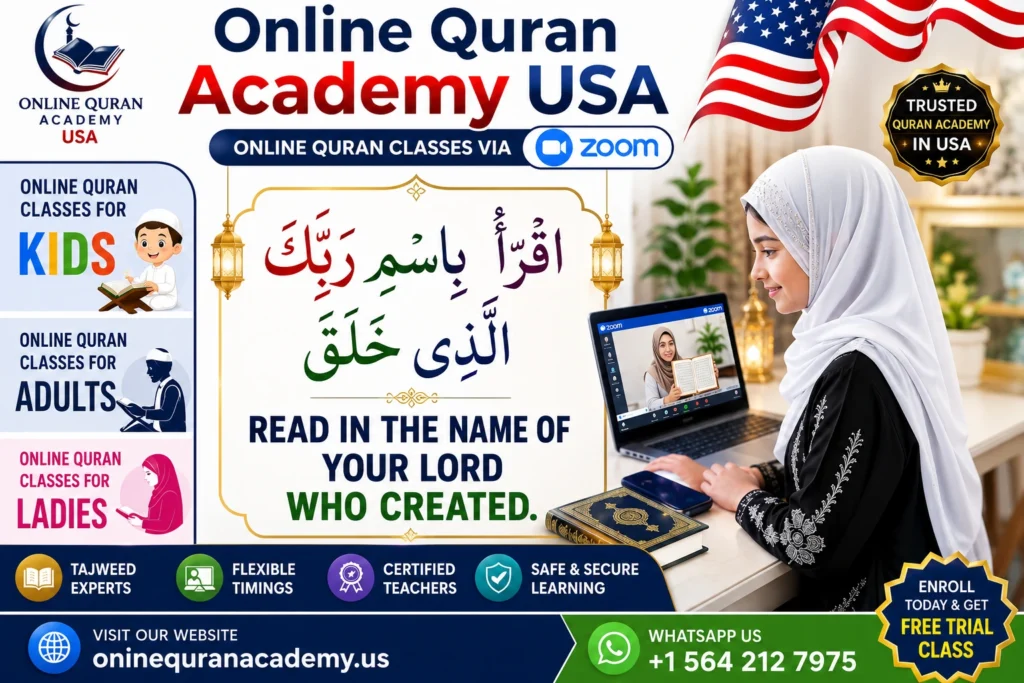
In simple terms, Online Quran Classes Via Zoom in USA refers to live, real-time Quran lessons delivered one-on-one through the Zoom video conferencing app, where a certified tutor and a student in the United States connect over video, the tutor shares their screen showing the Quran or Noorani Qaida page, and the student reads aloud while receiving instant correction — functionally identical to a private, in-home tutor, minus the commute.
Quick Answer: Key Facts at a Glance
- Classes are live and one-on-one, not pre-recorded videos
- Tutors are Al-Azhar University graduates with verifiable Ijazah credentials
- Both male and female teachers are available for kids, adults, and sisters
- Sessions run on Zoom, Skype, or Microsoft Teams depending on family preference
- A free trial is available before any payment is required
- Students are matched and scheduled within 24 hours of registration
Why Thousands of American Muslim Families Choose Zoom Quran Classes Over In-Person Madrassahs
Local Islamic centers and weekend madrassahs still matter, but they were never built for the pace of American life. Long commutes, waitlists for female teachers, rigid weekday schedules, and a shortage of Ijazah-holding instructors push families toward online Quran learning instead. Zoom solves the practical problems: no driving, no weather cancellations, and a session that starts the moment your child logs in.
- No commute or safety concerns — your child studies inside your own home
- Flexible scheduling around school, work, sports, and family life
- True 1-on-1 attention instead of a classroom of fifteen students
- Screen-sharing lets the tutor point directly at the Mus’haf page your child is reading
- Sessions can be recorded for revision — a feature physical classrooms cannot offer
- Access to Al-Azhar certified Quran tutors regardless of which state or city you live in
There is also a simple supply-and-demand reason behind this shift. There are only so many Ijazah-holding, Al-Azhar-trained scholars physically living within driving distance of any single American suburb. By moving the classroom online, a family in a small town in Iowa gains access to the exact same caliber of teacher available to a family in Dearborn or Brooklyn — something a physical madrassah simply cannot offer without that scholar relocating.
Understanding Ijazah and Sanad: Why Credentials Matter More Than Marketing
Two terms come up constantly when comparing Quran teachers, and most websites never explain them. An Ijazah is a formal certificate of authorization confirming that a teacher has mastered a specific recitation and is licensed to teach it to others. A Sanad is the unbroken chain of narrators connecting that teacher’s recitation, teacher-to-teacher, all the way back to the Prophet Muhammad ﷺ. Together, they are the closest thing Islamic scholarship has to a verifiable diploma with a documented history — which is exactly why we name each tutor’s credentials in this guide rather than using the word “qualified” as a stand-alone marketing claim.
When you speak with any prospective academy, it is entirely reasonable to ask which specific Riwayah (narration, such as Hafs ‘an ‘Asim, the most common recitation among American Muslims) a tutor is licensed to teach, and to ask whether their Ijazah documentation can be shown. A tutor confident in their training will never be uncomfortable answering that question directly.Trustpilot Reviews
How Live Quran Lessons on Zoom Actually Work — Step by Step
Step 1: Register and Claim Your Free Trial
You fill out a short form on our contact page with your name, age, current Quran level, and whether you would prefer a male or female tutor. It takes under two minutes, and there is no payment information required to begin your free trial.
Step 2: Tutor Matching Based on Level, Age, and Gender Preference
Our academic team reviews your details and matches you with a tutor suited to your goals — whether that is Noorani Qaida for a complete beginner or advanced Tafseer for someone who already reads fluently. You receive your Zoom link and a confirmed time within 24 hours.
Step 3: Your First Live Session
At the scheduled time, you simply tap the Zoom link from your phone, tablet, or laptop. The tutor shares their screen, opens the Quran page or Noorani Qaida chart, and begins reading with you. Camera-on or camera-off is your choice — many sisters prefer audio-first sessions, and that is completely acceptable.
Step 4: Ongoing Progress Tracking
After the trial, parents receive a monthly progress report covering Tajweed accuracy, memorization pace, and areas that need more practice. You can request a different tutor at any time at no extra cost if the personality fit is not right.
Meet Our Al-Azhar University Certified Quran Teachers
A Quran teacher’s credentials matter more than almost anything else in this decision. Al-Azhar University in Cairo, Egypt is the oldest continuously operating Islamic university in the world, and a degree from its Faculty of Quranic Studies or Usul al-Din is widely regarded as the gold standard of Quranic scholarship. Every tutor profiled below has completed formal study at Al-Azhar and holds an Ijazah with a documented chain of transmission (Sanad).
Ustadh Ahmed Al-Farouk — Senior Tajweed & Hifz Instructor
Ustadh Ahmed graduated from the Faculty of Quranic Studies at Al-Azhar University and holds an Ijazah in the Hafs ‘an ‘Asim recitation with an unbroken Sanad. He has taught Quran memorization and Tajweed to students across the USA and Canada for more than eleven years, with a specific focus on helping non-Arabic speaking children build correct Makharij (letter articulation) from their very first lesson.
Ustadha Fatima El-Sayed — Female Quran Tutor for Sisters & Kids
Ustadha Fatima is an Al-Azhar graduate and one of our most requested female Quran tutors. She has spent nine years teaching sisters, converts, and young girls in a private, comfortable setting, and is known for her patience with complete beginners who are reading Arabic letters for the very first time as adults.
Ustadh Mahmoud Rashid — Tafseer & Arabic Language Specialist
Ustadh Mahmoud studied Usul al-Din at Al-Azhar University with a concentration in Tafseer and classical Arabic grammar. He leads our Online Quran Tafseer Course and Quran translation classes, helping adult students move beyond recitation into genuinely understanding the meaning of what they read.
Ustadha Maryam Idris — Noorani Qaida & Kids’ Program Lead
Ustadha Maryam is an Al-Azhar-trained instructor who specializes almost exclusively in early-childhood Quran education. She designed much of our current kids’ curriculum structure, focused on keeping children between ages four and eight engaged through short, milestone-based sessions rather than long, static lessons.
About Al-Azhar University itself: founded in 970 CE in Cairo, Al-Azhar is recognized across the Muslim world as one of the most authoritative centers for Quranic and Islamic scholarship, and its Fatwa and teaching standards are referenced by scholars and institutions internationally. When an academy states a tutor graduated from Al-Azhar, that claim can be independently verified — which is precisely why we name it directly rather than using it as a vague background detail.
Complete Curriculum: What You Can Learn in Our Online Quran Zoom Classes
Our courses are designed so a student can start from the Arabic alphabet and progress all the way to advanced Tafseer without ever changing academies. Each course below links to a full breakdown of what is covered, typical session length, and who it is best suited for.
- Noorani Qaida — the foundational course for absolute beginners, covering Arabic letter recognition, correct sounds, and basic joining rules before a student ever opens the Quran itself
- Quran Recitation — building fluent, confident, correctly pronounced reading through repeated guided practice with a tutor
- Quran Tajweed — mastering the rules that govern correct recitation, including Makharij, Ghunnah, and the rules of Noon Sakinah and Meem Sakinah
- Quran Memorization (Hifz) — a structured, revision-heavy path toward becoming a Hafiz or Hafiza, paced to the individual student rather than a fixed class calendar
- Quran Translation — understanding the meaning of each verse in clear English alongside the Arabic text
- Quran Tafseer — in-depth interpretation, historical context (Asbab al-Nuzul), and scholarly commentary
- General Quran Learning — a comprehensive program combining reading, Tajweed, and basic Islamic studies for students who want a well-rounded foundation
- Meet Our Quran Tutors — browse full instructor profiles, specialties, and availability
How to Choose the Right Online Quran Academy: A Practical Checklist
Whichever academy you eventually choose, ask these questions before enrolling your child or yourself:
- Can they name the specific university or institution where the tutor studied, rather than just saying “qualified”?
- Is there a genuine, no-obligation trial with your actual assigned tutor, not a generic sales consultation?
- Do they offer a female tutor option for sisters and young girls without extra cost or a long waitlist?
- Is there a clear child-safety policy covering background checks and private session links?
- Are fees and refund terms published clearly, or do you have to ask repeatedly to get a straight answer?
- Can you request a replacement tutor if the personality fit isn’t right, without losing money or restarting the process?
If an academy’s website cannot answer these clearly, that is usually a sign the organization itself has not thought them through — which matters far more once real children are involved.
Online Quran Classes for Kids in USA via Zoom
The best age to begin is younger than most parents expect. Our online Quran classes for kids welcome children as young as four years old, using colorful Noorani Qaida charts, short attention-friendly sessions, and constant positive reinforcement. Tutors are trained specifically to hold a young child’s attention through a screen rather than in a physical room, which is a very different skill from traditional madrassah teaching.
Every session can be observed live by a parent, and our kids’ learning program includes monthly report cards so you always know exactly how your child is progressing — no surprises at the end of the year.
Sessions for younger children typically run 30 minutes to keep focus high, while older kids (ages 9 and up) often move to 45-minute sessions once they are used to the format. Tutors break lessons into small, achievable milestones — a new letter, a new rule, a new short Surah — so children experience frequent wins rather than long stretches of repetition, which is a large part of why retention rates stay high even among children who struggled to sit still in a physical classroom.
Siblings can also be scheduled back-to-back with the same tutor on the same day, which many parents find easier to manage than juggling separate appointment times across multiple children and multiple platforms.
It Is Never Too Late: Online Quran Classes for Adults
A large share of our students are adults — converts reading Arabic letters for the first time, professionals who never finished their Quran education growing up, and parents who want to learn alongside their children. Sessions are completely private, judgment-free, and scheduled around work hours, including early mornings and late evenings across every US time zone.
Adult learners often start hesitant, worried that they are “too old” or “too far behind.” In practice, adults tend to progress faster through Noorani Qaida than children because they can apply grammar logic consciously — the challenge is almost always time, not ability. That is precisely why flexible Zoom scheduling matters so much for this group: a 6:00 AM session before work or a 9:00 PM session after the kids are asleep is often the only way an adult can commit consistently, and that flexibility simply is not possible with a fixed-schedule physical class.
Female Quran Tutors Online — A Private, Comfortable Space for Sisters
Many sisters and mothers specifically search for a female instructor, and for good reason — privacy and comfort directly affect how quickly a student progresses. Our female Quran tutor team is entirely Al-Azhar certified, holds the same academic standard as our male tutors, and teaches everything from Noorani Qaida to advanced Tafseer in a fully private one-on-one session.
Requesting a female tutor never involves an additional fee, a separate application, or a waitlist reserved for male students first. It is simply a preference field on the same registration form, matched the same day as every other request.
The Role of Tajweed in Correct Worship
Tajweed is often the most misunderstood word in this field. It is not a separate subject unrelated to daily prayer — it is the set of pronunciation rules that determine whether a verse is recited the way it was revealed. A single mispronounced letter can change the meaning of a word entirely, which is why classical scholarship treats correct Tajweed as closely tied to correct worship rather than an optional add-on. Our Tajweed program is taught the same way it would be taught in a traditional Al-Azhar classroom, adapted only in delivery method — not in academic rigor.
How We Measure Student Progress
Every student’s journey is tracked against a simple, visible framework rather than vague impressions of “doing well.” Tutors log accuracy in Makharij, consistency in applying Tajweed rules, memorization retention (for Hifz students), and reading fluency at the end of each month. Parents receive this report directly, and adult students can request the same breakdown for themselves. This turns an otherwise abstract subject into something a family can actually watch improve month over month — which is often what keeps motivation high long after the initial excitement of enrollment fades.
Weekend and Evening Scheduling Options
For families where weekday afternoons are already committed to school, sports, or work, weekend Quran classes remain one of the most requested scheduling options. Saturday and Sunday sessions are available in morning, afternoon, and evening slots across every US time zone, using the exact same certified tutors as weekday classes — there is no separate “weekend-only” tutor pool or reduced quality trade-off.
Zoom vs Skype vs Microsoft Teams: Which Platform Works Best for Quran Learning?
All three platforms can deliver a live Quran lesson, but they are not identical. Zoom’s screen annotation tools let a tutor circle a Tajweed mistake directly on the Mus’haf page in real time, and its mobile app tends to be the most stable on older Android devices common among grandparents joining a family lesson. Skype Quran classes remain a reliable backup for households that already use Skype for family calls, while Microsoft Teams is often preferred by students who want built-in session recording for later revision. We support all three, and your assigned tutor will confirm which platform suits your household during registration.
If your household already has a preferred platform for family video calls, it is worth mentioning that preference during registration — tutors are trained across all three tools, so switching platforms never means switching to a less experienced teacher.
Transparent Fee Packages — No Hidden Charges
Cost is one of the top concerns American Muslim families raise before enrolling. Every fee package we offer includes live 1-on-1 sessions, a free replacement tutor if the fit is not right, monthly progress reports, and your choice of a male or female tutor at no additional charge. There is no cost to try your first sessions, and no credit card is required to start.
Packages are generally structured around weekly session frequency (2, 3, or 5 days per week) and session length (30 or 45 minutes), with discounted rates for enrolling siblings from the same household. Exact current pricing is kept up to date on our fee packages page rather than repeated here, since course pricing is one of the few details worth double-checking directly before enrollment.
What You Need Before Your First Class: Technical Requirements
One of the biggest advantages of Zoom-based Quran learning is how little equipment it actually requires. Before your first session, make sure you have:
- A smartphone, tablet, laptop, or desktop computer with a working camera and microphone
- The free Zoom app installed (available on iOS, Android, Windows, and Mac)
- A stable internet connection — even a basic home Wi-Fi or 4G/5G mobile connection is sufficient
- A quiet, well-lit space where the student can read comfortably and the tutor can see the Quran page if needed
- A physical Mus’haf (Quran copy) or Noorani Qaida book, if your tutor prefers to work from a printed copy alongside the shared screen
Our support team will walk first-time users through the Zoom setup on a quick call if needed — many of our adult and elderly students had never used Zoom before their very first class with us.
Child Safety and Privacy During Zoom Quran Lessons
Parents are right to be cautious about who their child interacts with online. Every tutor on our team completes a background verification process before being assigned any student, and every session link is generated privately and sent only to the registered parent’s email or WhatsApp — never posted or shared publicly. Parents are always welcome to sit in on any session, and camera use is entirely the family’s choice.
Beyond tutor vetting, we recommend a few habits every family should follow regardless of which academy they choose: always join sessions from a shared family space rather than a closed bedroom for younger children, keep the Zoom meeting link private rather than reusing it across platforms, and review the monthly progress report together as a family so learning stays a visible, shared activity.
- Session links are unique per class and expire after use — never reused or shared publicly
- All tutors undergo identity and background verification before their first assigned student
- Parents may join, observe, or record any session at their own discretion
- Camera-on is never mandatory — audio-only sessions are fully supported for families who prefer it
Coverage Across All 50 US States and Every Time Zone
Because classes are delivered entirely online, geography stops being a barrier. We currently teach students in New York, Los Angeles, Houston, Chicago, Dallas, Atlanta, Detroit, Philadelphia, and hundreds of smaller US cities, with tutors available across Eastern, Central, Mountain, and Pacific time — including dedicated weekend slots for families whose weekdays are already full.
This matters most for Muslim families living in smaller towns and rural areas where the nearest mosque with a dedicated Quran program might be an hour’s drive away, or where no local program offers a female tutor at all. A family in rural Montana or small-town Vermont now has access to the exact same Al-Azhar certified teaching available in Dearborn, Michigan — the single biggest practical shift online Quran education has brought to Muslim life in America over the past decade.
Common Mistakes Other Online Quran Academies Make — And How to Spot Them
Before choosing where your child (or you) will study, it helps to know what to watch for. After reviewing how several other Quran-by-Zoom websites present themselves, a clear pattern of avoidable mistakes shows up again and again:
- Unverifiable “qualified teacher” claims — many sites describe tutors as “qualified” or “experienced” without naming a university, a certification body, or an Ijazah chain. A real credential can be named and checked; a vague adjective cannot.
- No named author or reviewer — content with no byline and no subject-matter reviewer gives a search engine and a parent no way to judge who actually wrote it or whether an Islamic scholar reviewed it for accuracy.
- Keyword stuffing over readability — several competitor pages repeat the word “Zoom” in nearly every sentence in a way that reads unnatural and adds no new information, which hurts both the reader’s experience and how modern search and AI answer engines evaluate the content.
- Generic, unsupported trust numbers — phrases like “thousands of happy families” appear frequently with no evidence, timeframe, or source behind the number.
- No child-safety or privacy information — very few competing pages mention background verification, private session links, or parent-observation policy, which is often the single biggest concern for a parent enrolling a child.
- Thin, repetitive content with no real structure — long unbroken paragraphs mixing unrelated topics (fees, refunds, terms and conditions, testimonials) make it hard for a reader — or an AI assistant summarizing the page — to extract a clear answer.
- No FAQ or direct-answer sections — this makes it harder for the page to be picked up by voice search, AI overviews, and answer engines that reward clear, structured question-and-answer content.
- Overselling “free trial” without real teaching content — a small number of academies use the trial purely as a sales funnel rather than a genuine assessment of a student’s level, which wastes a family’s time before they even see actual teaching quality.
We built this guide the opposite way: named tutors with named credentials, a reviewer byline, real testimonials, a dedicated safety section, and direct answers in the FAQ below. None of this is difficult to do — it simply requires treating parents as informed decision-makers rather than as a page to be ranked.
Real Stories: What Our Students and Parents Say
“My son is seven and has the attention span of a goldfish in person, but somehow he sits still for his Zoom Quran class every single week. Ustadh Ahmed knows exactly how to keep him engaged.” — Amina R., Houston, TX
“I converted to Islam two years ago and was embarrassed to start reading Arabic letters as an adult. Ustadha Fatima never once made me feel behind. I finished Noorani Qaida in four months.” — Sarah K., Chicago, IL
“We tried two other online academies before this one. The difference was obvious in the first free trial class — actual teaching, not a sales pitch.” — Yusuf M., Dearborn, MI
“Having a female tutor for my daughters made all the difference. They look forward to their lessons every week.” — Layla H., Los Angeles, CA
“Ustadh Mahmoud’s Tafseer classes changed how I read the Quran. I finally understand the context behind verses I’ve recited my whole life.” — Omar T., New York, NY
“As a working mother, the 8 PM slot was the only thing that made this realistic for us. Three months in and my daughter now reads Surah Al-Kahf on her own.” — Nadia S., Atlanta, GA
“I was skeptical about learning Tajweed over a screen, but the tutor’s screen annotation made it easier to see exactly where my mistakes were.” — Bilal A., San Francisco, CA
Frequently Asked Questions About Online Quran Classes Via Zoom in USA
Is it possible to learn Quran properly over Zoom, or is in-person always better?
Live 1-on-1 Zoom lessons let a qualified tutor hear every word a student reads and correct mistakes in real time, which is the core requirement for proper Quran learning — the same standard used in traditional in-person Talaqqi teaching, just delivered through video instead of a physical room. What matters most is not the medium but whether the tutor can hear, correct, and repeat with the student in real time, which Zoom fully supports.
Do I need to download anything besides the Zoom app?
No. A smartphone, tablet, or computer with the free Zoom app and a stable internet connection is all that is required. Your tutor sends the session link before each class.
What age should my child start online Quran classes?
Children as young as four can begin with Noorani Qaida. There is no upper age limit for adult students — some of our learners are in their sixties and seventies.
Are your tutors really certified by Al-Azhar University?
Yes. Every tutor referenced in this guide is a verified Al-Azhar University graduate holding a documented Ijazah, and credentials can be confirmed through our tutor profiles page.
Can my daughter or wife learn with a female-only teacher?
Yes. Our female Quran tutor team teaches sisters and girls exclusively, with no male teacher involvement unless specifically requested.
Is there really a free trial, or is it a sales call in disguise?
Our trial consists of real teaching sessions with your actual assigned tutor — the same lessons you would receive as a paying student — with no credit card required to begin.
How much do online Quran classes cost in the USA?
Pricing depends on the course and weekly frequency you choose. Full details are listed transparently on our fee packages page, with no hidden charges.
What if my child doesn’t get along with the assigned tutor?
You can request a free tutor replacement at any time — there is no extra charge and no lengthy process involved.
Can adults with no prior Quran reading experience really learn on Zoom?
Yes. Many of our adult students, including converts, begin with zero Arabic reading ability and complete Noorani Qaida within three to six months of consistent weekly sessions.
Do you offer classes outside the USA as well?
While this guide focuses on our USA-based students, the same online Quran classes and tutor team are also available to students in the UK, Canada, and Australia.
How long does it typically take to complete Noorani Qaida?
Most children complete Noorani Qaida in four to eight months with consistent weekly sessions, while motivated adults often finish in three to six months, since they can apply grammatical logic more quickly than young children.
Will my child be taught the same recitation style used in our local mosque?
Yes — the vast majority of American mosques follow the Hafs ‘an ‘Asim narration, which is the recitation style our tutors are Ijazah-certified to teach, ensuring consistency between what your child learns online and what they hear at the mosque.
Start Your Free Trial of Online Quran Classes Via Zoom in USA Today
Choosing the right Quran academy is a decision that shapes your child’s relationship with the Quran for life. Verify the credentials, ask about safety policies, and read real reviews before you commit anywhere — including with us. When you are ready, register for your free trial and experience a live lesson with an Al-Azhar certified tutor for yourself.
There is no pressure, no long-term contract required to start, and no cost to see whether this approach fits your family. Thousands of American Muslim households already learn this way — the only step left is booking your first class.
