 Skip to content
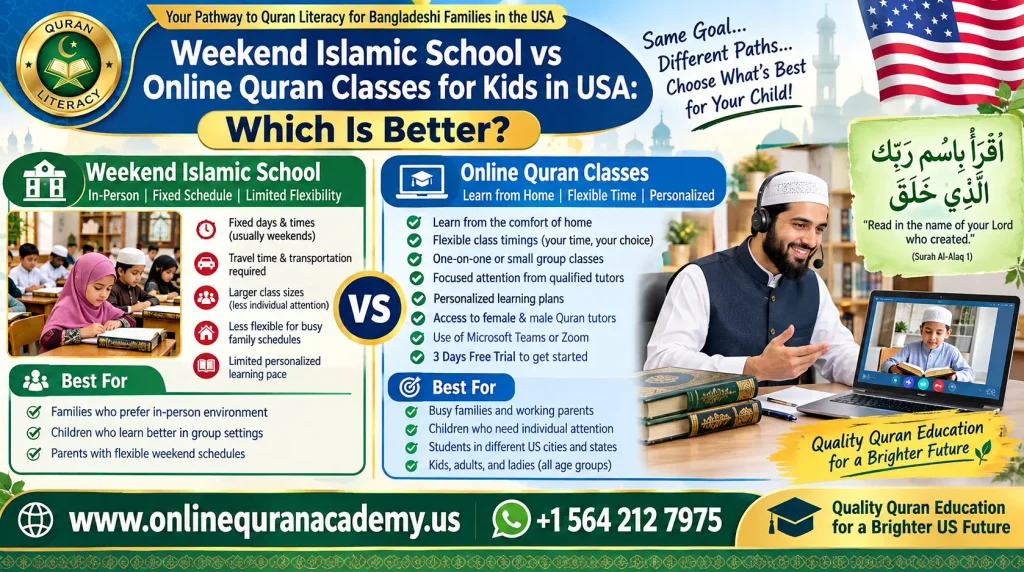
If you are raising Muslim children in America, you have probably asked yourself this at least once: should my child spend Saturday or Sunday mornings at a mosque school, or learn the Quran with a private teacher on a screen at home? The Weekend Islamic school vs online Quran classes for Kids in USA for kids in USA debate is one of the most common worries parents bring up, and it deserves a straight answer instead of a sales pitch.
Here is the honest short version. Neither option is automatically better. Each one solves a different problem. Weekend schools give children a peer community and a place to belong. Online lessons give children something a crowded classroom rarely can, which is a teacher’s undivided attention on their recitation. This guide compares both side by side so you can match the format to your child, not to a trend.
We are Online Quran Academy, a USA-based academy that teaches online, so you should know where we stand. We will still tell you where a weekend school is the better call, because a good decision serves the child, not the provider.
Quick Answer
Choose a weekend Islamic school if your child learns best in a group, you live near a well-run masjid, and community matters as much as recitation. Choose online Quran classes if your child needs one-on-one Tajweed correction, your schedule is packed, or there is no reliable school nearby. For many American families, the strongest result comes from using both: a weekend school for belonging and Islamic studies, plus a short weekly online lesson for recitation.
What Is a Weekend Islamic School in the USA?
A weekend Islamic school is a part-time program that meets on Saturdays or Sundays, usually inside a mosque or community center. Children attend for a few hours alongside their peers, then go back to their regular public or private school on Monday. In cities with large Muslim populations, these programs are a central part of Islamic education for children in America.
How a typical weekend program runs
Families sometimes call it Sunday school Islamic for kids, or simply a weekend Quran school for children. Most weekend schools divide the day into blocks: Quran reading or memorization, Islamic studies, Arabic basics, and sometimes Seerah or character building. Students are grouped by age or reading level. Many programs run on the same calendar as local public schools, with breaks for holidays and summer, and a good number are volunteer-supported or donation-based, which keeps tuition modest. Quality varies widely from one program to the next, so a strong reputation at one masjid tells you little about the one across town.
Who weekend schools suit best
They work well for sociable children who enjoy learning with friends, for families who want their kids to see other Muslim children in an ordinary, everyday setting, and for parents who value the masjid as a weekly anchor. If you want your child to feel normal about being Muslim in a mostly non-Muslim school, a weekend classroom full of peers can do something that no screen can.
What Are Online Quran Classes for Kids?
Online Quran classes are live lessons delivered over video, usually one-on-one, between a child and a qualified teacher. Instead of driving anywhere, your child sits at a laptop or tablet at home. A good online Quran academy for kids assigns a teacher, sets a schedule around school hours, and tracks progress from the first Arabic letter onward. Many parents search for Quran lessons for children online because they want a teacher they can trust without a long drive, and our page on Quran lessons for children online explains the options. If you want to see what this looks like in practice, our page on online Quran classes for kids USA walks through the format.
How a typical online lesson runs
Sessions are commonly around 30 minutes, held two to five days a week, on platforms such as Microsoft Teams or Zoom. The teacher shares the Quran or Qaida page on screen, listens to the child recite, corrects each mistake as it happens, and assigns practice for the next class. Because the child is the only student, every minute of the lesson is spent on that child’s reading. This is the model behind one-on-one Quran classes for kids.
Who online classes suit best
They suit children who need extra attention, families with crowded weekends, and parents who live far from a mosque school. They also suit children who feel shy or behind in a group, and families who prefer a female teacher for their daughters. Many families choose Quran classes for kids at home precisely because they can supervise the class without leaving the house. Some academies also bundle online Islamic classes for kids, covering duas, salah and manners, alongside Quran reading, so children get a little of both worlds.
Weekend Islamic School vs Online Quran Classes for Kids in USA: Side-by-Side Comparison
Before we go deeper, here is the comparison most parents are really looking for. The details vary by school and by academy, so treat this as a general guide rather than a rule.
| Factor | Weekend Islamic school | Online Quran classes |
| Schedule | Fixed weekend hours | Flexible; set around school and activities |
| Class size | Group of 8 to 20 or more | Usually one-on-one |
| Recitation time per child | A few minutes per class | Most of the lesson |
| Peer community | Strong; children meet other Muslim kids | Limited unless combined with other activities |
| Travel | Commute both ways, every week | None |
| Teacher choice | Assigned by the school | Often can request male or female, trial with different teachers |
| Curriculum breadth | Broad: Quran, Islamic studies, Arabic, events | Depends on the academy; strongest in Quran, Tajweed, Hifz |
| Parent visibility | Limited during class | Parent can sit nearby and observe |
| Missed classes | Content missed unless a make-up exists | Usually easy to reschedule |
| Typical cost | Often lower; sometimes donation-based | Varies; many academies offer monthly plans and a free trial |
Read the table the way you would read a school report. There is no column that wins everything. Weekend schools lead on community and breadth. Online classes lead on individual attention, flexibility, and parental oversight. The right choice depends on which of those your child needs most right now.
Pros and Cons of Weekend Islamic School
What weekend schools do well
- Belonging. Children see that being Muslim is normal, shared, and joyful. That matters enormously for kids who are one of very few Muslims at their public school.
- Broader Islamic education. Many programs teach Islamic studies, manners, duas, and Arabic alongside Quran reading, and they celebrate Ramadan and Eid together.
- Routine. A fixed weekly slot builds a habit that some children need and enjoy.
- Family connections. Parents meet other parents. Friendships that begin in the classroom often last into the teen years.
- Lower cost. Because many programs are community-supported, tuition is often modest compared with private tutoring.
Where weekend schools struggle
The biggest limitation is simple arithmetic. If a class has twelve children and thirty minutes is set aside for Quran reading, each child may recite aloud for only two or three minutes. That is fine for a child who already reads well, but it is thin for a beginner still learning letters and sounds. Mistakes in pronunciation can go uncorrected for months, and by then they have turned into habits.
Other common challenges include schedules that clash with sports and travel, volunteer teachers without formal Tajweed training, uneven quality between programs, and long commutes in large metro areas. None of these is universal, but ask about them before enrolling.
Pros and Cons of Online Quran Classes for Kids
What online classes do well
- Personal correction. The teacher hears every word your child says and fixes mistakes right away, which is how good Tajweed is built.
- A pace that fits the child. A quick learner is not held back and a struggling learner is not rushed.
- Flexible timing. Classes can be scheduled after school, before dinner, or on weekends across US time zones.
- Access to qualified teachers. You are not limited to whoever lives near your masjid. Families in small towns and rural areas can learn from certified teachers, including female Quran tutors for girls who are more comfortable with a woman teacher.
- No commute. You get back the hours spent in the car.
- Easy parental oversight. You can hear the lesson, see the progress, and step in if your child is distracted.
Where online classes struggle
Online learning has real downsides, and a trustworthy academy will admit them. Young children can tire of screens. Some kids get distracted by other tabs, siblings, or the family dog. The learning is also more solitary, so your child will not automatically make Muslim friends through it. And quality depends heavily on the academy: a poorly run online class can be worse than a decent weekend school.
Most of these problems can be managed. Short sessions, a quiet corner, a parent nearby for younger children, and a teacher who keeps lessons interactive make a big difference. The friendship gap is best filled by pairing online lessons with masjid activities, youth programs, or family gatherings.
Which Format Works Better for Noorani Qaida, Tajweed and Hifz?
Not every part of Quran learning has the same needs. Here is how the two formats tend to compare for the most common courses.
Noorani Qaida for beginners
Noorani Qaida is the foundation: Arabic letters, their sounds, and how they join to make words. This stage rewards close listening, because a child who mispronounces a letter will repeat that mistake in every verse afterward. One-on-one lessons have a clear edge here. A dedicated Noorani Qaida course lets the teacher stay on a single sound until it is right, then move on. Weekend schools can still do a good job when the class is small and the teacher is experienced.
Tajweed and fluent reading
Tajweed depends on hearing the exact sound a child produces and correcting it in the moment. It is also very difficult to fix a long-standing error later. For that reason, many parents choose a focused online Tajweed course even when their child attends a weekend school for everything else.
Hifz and memorization
Memorization depends on daily practice, not weekly attendance. A child who memorizes new lines and revises old ones every day needs a teacher who checks that work several times a week. That is difficult to deliver once a week in a group. Structured online Quran memorization programs are built around daily new lessons, recent revision, and older review, which is why many Hifz students combine home practice with frequent short lessons.
Cost, Time and Convenience: What Each Option Really Takes
Cost is not just tuition. It is money, hours, and family energy.
Weekend schools often charge less per month, and some run on donations. But add the travel. If your masjid is thirty minutes away, that is an hour of driving each weekend, roughly fifty hours a year, plus the cost of gas and the loss of a free weekend morning.
Online classes usually charge a monthly fee that depends on how many days a week your child studies and how long each class runs. Some academies advertise entry plans in the range of thirty to forty dollars per month for a couple of half-hour classes each week, though prices differ and you should always confirm what is included. Look for a free trial, no long-term contract, and a clear policy on make-up classes.
A fairer comparison is cost per minute of individual recitation, not cost per month. A cheap class where your child recites for three minutes may deliver less than a modest plan where she recites for twenty-five.
Safety, Supervision and Parent Involvement
Neither format deserves blind trust, so ask questions about both.
For online classes, look for a platform where only the teacher and your child are present, no public chat, and a parent free to sit in. Ask whether teachers are background-checked and interviewed, and whether lessons can be observed or reviewed. Keep the device in a shared space.
For weekend schools, ask about volunteer screening, the adult-to-child ratio, and how the school handles discipline. A good masjid program will answer these questions calmly. If a school or an academy is vague or defensive, treat that as useful information.
Whichever you choose, stay involved and listen to your child recite.
Which Is Better for Your Child? A Guide by Age and Situation
Ages 4 to 6
Young children need short, warm, playful sessions. A small, gentle weekend class can be wonderful. So can online lessons of 20 to 30 minutes with a patient teacher and a parent beside them. Avoid long sessions at this age in either format.
Ages 7 to 11
This is the sweet spot for building reading fluency and Tajweed, and the age where the hybrid approach shines: a weekend class for friends and Islamic studies, plus a couple of online lessons each week to keep recitation accurate.
Teens
Teenagers are busy and sensitive about being embarrassed. Many prefer the privacy of a one-on-one lesson, especially if they feel behind their peers. At the same time, a youth halaqa or weekend circle helps them find their community. Let teens help choose; they stick with what they pick.
Shy children, and children who feel behind
A child who freezes when others are listening may barely recite in a group class. One-on-one lessons remove that pressure and build confidence quickly. For girls and sisters who are more comfortable with a woman teacher, the option of a female tutor is often the deciding factor.
Families with no Islamic center nearby, or with a packed schedule
If the nearest weekend school is far away, or if sports, work shifts, and family obligations make weekends unpredictable, online classes are often the only format that will actually happen consistently. And consistency beats an ideal plan you cannot keep.
The Hybrid Approach: Why Many Families Use Both
The most useful shift is to stop treating this as either-or. The two formats do different jobs.
Picture a nine-year-old named Amina. On Saturdays, she attends a weekend Islamic school where she sees her friends, learns about the Prophets, and takes part in the Eid program. During the week, she has two 30-minute online sessions with a Tajweed teacher who fixes her pronunciation and tracks her reading level. The weekend school builds her identity. The online lessons build her recitation. Neither one is trying to do the other’s job.
If budget or time allows only one, choose based on your child’s biggest need. If it is friendship and belonging, lean toward the weekend school. If it is accuracy and confidence in reading, lean toward one-on-one online lessons. You can always add the other later.
How to Find an Islamic Weekend School Near Me, and Where Online Fits
If you are searching for an Islamic weekend school near me, start with the people around you. Ask at your local masjid, check the websites and community pages of nearby Islamic centers, and talk to parents whose children attend. Visit a class before you enroll.
Searching for a weekend Islamic school USA wide returns thousands of results, so narrow it down by city. Availability varies a lot by region. Here is a general picture, keeping in mind that the best options are always local and worth verifying yourself.
New York and New Jersey
Families searching for a weekend Islamic school in New York or Quran classes for kids in New Jersey usually find plenty of mosque-based programs, but long commutes and crowded classes are common complaints. Many parents in the tri-state area add online lessons for one-on-one reading practice. You can read more about online Quran classes in New Jersey if that applies to you.
Texas and Houston
A weekend Islamic school in Texas is often within reach, but distances are big. Families looking for Quran classes for kids in Houston sometimes add online lessons for weekday practice because the weekend drive can eat a whole morning.
California
Parents looking for a weekend Islamic school in California can find strong programs in major metros, but traffic and waitlists can be a problem. Online classes can be scheduled around Pacific time and after-school activities.
Chicago and Dearborn, Michigan
If you are searching for an Islamic Sunday school in Chicago or an Islamic school near Dearborn Michigan, you will likely have real choices. The question is fit, and a trial class, in person or online, settles it.
Florida, Virginia and Atlanta
Families searching for online Quran classes for kids in Florida often do so because communities are spread out. Parents seeking a Quran teacher for kids in Virginia or Quran classes for kids in Atlanta commonly combine a local weekend program with a private online teacher. In smaller towns anywhere in the country, online learning may be the most practical way to reach a qualified teacher at all.
How to Choose the Best Quran Classes for Children in America
Whichever format you lean toward, and whichever Quran classes for kids in USA you are considering, the same quality checks apply. A short list of good questions will tell you more than any advertisement.
Check teacher qualifications
Ask what training the teachers have in Tajweed, whether they hold an ijazah, and how the academy or school selects them. A qualified teacher can explain rules simply to a child and correct mistakes patiently. You can review how certified online Quran tutors are typically vetted and matched before you decide.
Take a trial class first
A trial is the fastest way to see whether a teacher and child click. For a weekend school, ask to observe a class. For an online academy, book a free trial and sit in. Compare more than one option if you can. Our guide to the top online Quran academies in the USA offers a framework for weighing academies against each other.
Look for a clear curriculum and progress reports
You should be able to see where your child is and where they are going. A good program has defined levels, from Qaida to reading to Tajweed to memorization, and gives you regular updates. If nobody can tell you what your child will be able to do in three months, keep asking.
Confirm scheduling and time zones
Check that class times work in your time zone, that holidays and exams can be handled, and that missed classes can be made up. If you are choosing the best Quran classes for children in America, the best online Quran classes for kids in the USA will make this easy, not complicated.
Common Mistakes Parents Make
- Choosing on price alone. The cheapest option is not cheap if your child learns to mispronounce for a year.
- Expecting one format to do everything. Community and correction are different needs.
- Skipping the trial. A teacher can look great on a website and be a poor fit in person.
- Leaving it all to the teacher. Ten minutes of daily practice at home matters more than an extra weekly class.
Frequently Asked Questions
Can online Quran classes replace a weekend Islamic school?
For Quran reading, Tajweed, and memorization, they often can, and many children progress faster one-on-one. They do not replace the community and peer connection of a weekend school, so consider how your child will get that elsewhere.
Are online Quran classes effective for kids?
They can be very effective when lessons are live, one-on-one, and led by qualified teachers, and when a parent supports practice at home. Effectiveness depends far more on the teacher and the routine than on the screen.
Online Quran vs Islamic school: is one more authentic?
On the online Quran vs Islamic school question, authenticity comes from the teacher’s training and chain of learning, not the room. A teacher with a verifiable ijazah and solid Tajweed is authentic on video or in a classroom. Check credentials in both settings.
At what age should kids start Quran classes?
Many families begin around ages 4 to 6, depending on whether the child can focus for a short session. Starting with Noorani Qaida and keeping lessons brief works best.
How many days a week should kids attend?
More frequent, shorter sessions usually produce better results than one long weekly class. Online programs commonly offer two to five days per week. Choose a rhythm your family can actually maintain.
Are online Quran classes safe for children?
They can be, with the right precautions: one-on-one sessions on a secure platform, a parent nearby, a device in a shared space, and a vetted academy. Ask any provider to explain how it keeps students safe.
How much do weekend Islamic school and online Quran classes cost?
Weekend schools are often lower in tuition and sometimes donation-based. Online academies vary, and some advertise entry plans around thirty to forty dollars a month for two short classes weekly. Always confirm what is included, and compare cost per minute of individual attention. Trustpilot Reviews
Can my daughter learn with a female Quran teacher?
Yes. Many online academies offer female teachers, and many parents prefer this for girls. You can learn more about our female Quran tutors in USA and how they teach.
Final Verdict: Weekend Islamic School vs Online Quran Classes for Kids in USA
The choice between a weekend Islamic school USA families trust and online Quran classes for kids USA parents rely on comes down to what your child needs most today. If your child needs friends, a masjid family, and a broad Islamic education, a good weekend school is hard to beat. If your child needs accurate reading, personal attention, and a schedule that bends around a busy life, one-on-one online classes are hard to beat. And if you can, combining them gives you the best of both.
Muslim kids Quran learning USA wide looks different in every home and every mosque, and that is fine. Whatever you choose, start small, watch how your child responds, and adjust. The goal is not a perfect plan. It is a child who opens the Quran willingly and reads it well.
If you would like to see how one-on-one online learning feels before deciding, you can book a free trial with Online Quran Academy and sit in on the first lesson. To explore programs for the whole family, see our online Quran classes for kids and adults.
