 Skip to content
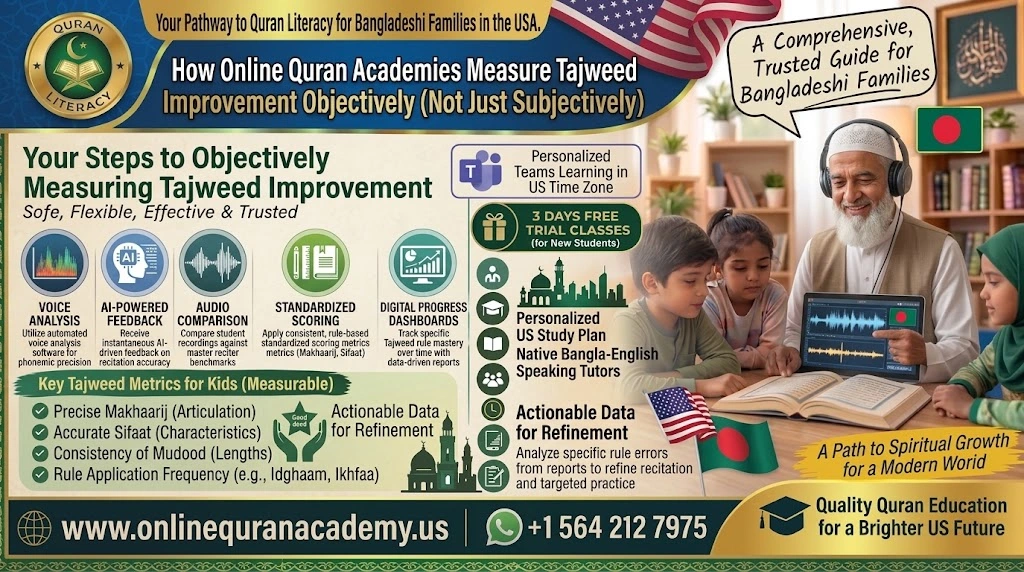
Every week, thousands of Muslim parents across the United States hear some version of the same sentence from a Quran teacher: “Your child is doing really well with their Tajweed.” It sounds reassuring. But reassuring is not the same as true, and it is certainly not the same as proven. Compared to what baseline? Measured against which rules? Written down where? For most families paying monthly for online Tajweed classes for kids USA or online Tajweed classes for adults USA, “doing well” is the only feedback they ever get, and it is simply not good enough for something as important as how their child or they themselves recite the words of the Quran.
Tajweed is not a feeling. It is a rule-based science with defined articulation points, defined letter characteristics, and defined recitation rules that either are or are not being applied correctly in a given recitation. Because it is rule-based, it can be measured the same way a driving instructor measures parallel parking or a swimming coach measures stroke technique: with a checklist, a recorded baseline, a scoring scale, and a second recording to compare against the first. This article explains exactly how online Quran academies measure Tajweed improvement Objectively why most of them still rely on vague subjective language instead of proof, and what an honest, evidence-based Tajweed assessment actually looks like for kids, adults, beginners, and reverts learning across every US state.
Why “Sounds Good” Is Not Evidence: Subjective vs Objective Tajweed Feedback
Subjective feedback is anything that depends entirely on one teacher’s impression in the moment: “You read that beautifully,” “Much better than last week,” “Your Makharij are improving.” None of these statements can be checked, repeated, or shown to a second teacher for confirmation. They may be true. They may also be polite filler designed to keep a paying family happy.
Objective feedback, by contrast, is anything that survives being written down and checked by someone else. “In the recorded passage from Surah Al-Fatiha, the student correctly applied Idgham in 4 out of 5 required instances, up from 2 out of 5 four weeks ago” is a claim that a second Tajweed teacher, or the parent themselves, can verify by listening to both recordings side by side. That is the difference this entire guide is built around, and it is the difference every parent searching for a genuine Tajweed assessment for kids USA or a Tajweed assessment for adults USA should be looking for before they enroll.
How Online Quran Academies Measure Tajweed improvement Objectively
Search for how competing platforms describe their progress tracking and a pattern emerges quickly. Many list the same handful of vague bullet points — “reading accuracy,” “pronunciation improvement,” “lesson completion” — without ever explaining what accuracy is measured against, what scale is used, or how a parent would independently confirm any of it. A monthly update that simply states a child is “improving” is a subjective opinion repeated on a schedule, not an objective Quran progress assessment for kids USA.
A second common mistake is treating memorization quantity and recitation quality as the same thing. An academy that reports “12 new verses memorized this month” has told a parent nothing about whether those 12 verses were recited with correct Makharij and Sifaat, or whether the same three Tajweed mistakes were repeated in every one of them. Quantity of material covered and quality of Tajweed application are two different metrics, and conflating them is one of the most common ways progress looks better on paper than it is in practice.
A third mistake is relying on asynchronous, written-comment feedback instead of live, synchronous correction paired with recorded comparison. Tajweed correction depends on hearing a letter the instant it is mispronounced; a teacher who only reviews a recording afterward and leaves a comment misses the real-time correction that actually changes a habit, and still has not produced a repeatable, scored comparison the family can see improving over time.
A well-built online Quran academy avoids all three mistakes by pairing live, one-on-one correction with a written, numeric, re-testable record — which is exactly what the framework below is designed to produce.
The Five Building Blocks of Objective Tajweed Measurement
1. Makharij Scoring — Where Every Letter Is Produced
Arabic has roughly seventeen articulation points (Makharij), grouped across the throat, the tongue, the lips, the nasal cavity, and the empty space inside the mouth and throat. A proper Makharij assessment for children or adult beginner does not ask “can the student say the letter” — it asks “is the student producing the letter from the correct point, every time, under normal recitation speed.” A tutor scores each letter group (throat letters like Ha and Ain, emphatic letters like Saad and Dhaad, lip letters like Ba, Meem, and Waw) on a simple scale, and that scale is recorded, not just spoken aloud.
2. Sifaat Scoring — The Natural Qualities of Each Letter
Sifaat are the built-in characteristics every Arabic letter carries: whether it is heavy (Tafkheem) or light (Tarqeeq), whether the airflow is stopped or continued, whether the sound is whispered or voiced. Two students can both hit the correct Makhraj for the letter Raa and still sound completely different if one applies the correct heaviness and the other does not. Scoring Sifaat separately from Makharij prevents an academy from calling a recitation “correct” when only half of the actual rule has been applied.
3. Rule-by-Rule Checklists
This is the heart of objective Tajweed assessment. Instead of a single overall grade, the tutor works through a checklist covering the rules of Noon Sakinah and Tanween (Izhar, Idgham, Iqlab, Ikhfa), the rules of Meem Sakinah, the rules of Madd (natural and secondary lengthening), Qalqalah, Ghunnah, and the rules of Waqf and Ibtida (where a reciter may correctly stop and restart). Each rule gets its own pass, needs-practice, or not-yet-applied marking inside the same recitation, so a Quran recitation test for kids or a Quran recitation evaluation for children shows exactly which two or three rules need attention next — not a vague overall impression.
4. Recorded Baseline and Re-Test Comparison
Every serious Quran reading assessment for children or adult should start with a recorded baseline: the student recites a short, fixed passage in week one, and that same passage — or an equivalent-difficulty passage — is recited again at a set interval, typically every four to six weeks. Comparing recording one to recording four is the single most convincing form of proof a parent can be shown, because it removes the teacher’s memory and opinion from the equation entirely. The recordings speak for themselves. Trustpilot Reviews
5. A Numeric Scoring Scale
None of the above matters if the results are not converted into numbers a parent can track over time. A simple 1–5 scale per rule (1 = rule not yet applied, 3 = applied inconsistently, 5 = applied correctly and consistently) turns four months of classes into a chart a parent can actually read at a glance, rather than four months of loosely remembered verbal updates.
What an Objective Tajweed Progress Report Should Actually Contain
| Tajweed Rule Checked | Baseline Score (Week 1) | Current Score (Week 8) | Tutor Note |
| Makharij accuracy (throat & emphatic letters) | 2 / 5 | 4 / 5 | Qaaf and Dhaad now consistent |
| Sifaat (heavy vs light letters) | 2 / 5 | 4 / 5 | Tafkheem on Raa improved |
| Noon Sakinah & Tanween rules | 1 / 5 | 3 / 5 | Ikhfa still needs weekly review |
| Madd (lengthening) rules | 3 / 5 | 5 / 5 | Fully consistent now |
| Qalqalah | 2 / 5 | 4 / 5 | Clear echo on Ba and Dal |
| Ghunnah (nasal sound) | 3 / 5 | 4 / 5 | Minor inconsistency on fast passages |
| Waqf & Ibtida (stopping/starting) | 2 / 5 | 4 / 5 | Confident on standard stop signs |
A Tajweed progress report for parents built this way answers three questions every time: where the student started, where they are now, and exactly which rule to focus on next. Compare that to a generic Quran learning progress report for parents that simply says “good progress this month” with no baseline, no scale, and nothing to compare it against.
Level-Based Milestones: Turning Tajweed Into a Measurable Path
Objective measurement works best when it is tied to a structured, leveled curriculum rather than an open-ended stream of lessons. Online Quran Academy’s own online Quran tajweed course is built in stages precisely for this reason — each level has a defined set of Makharij, Sifaat, and rules the student must demonstrate before moving to the next stage, and a written and oral assessment closes out every level. This gives families a second layer of objective proof beyond the weekly scorecard: a level completed is a level a certified tutor has formally signed off on, not just a teacher’s private impression that a student is “ready.”
Objective Assessment Looks Different for Kids, Adults, Beginners, and Reverts
Kids
For young children, objective measurement has to work around short attention spans and developing reading skills. The most reliable approach for children’s Quran learning assessment combines short, gamified rule checks (spotting Qalqalah letters in a game rather than a formal test) with the same recorded-passage comparison used for adults, scaled to age-appropriate material. Parents evaluating online Quran classes for kids with Tajweed USA should ask specifically how kids Quran reading progress and kids Tajweed improvement are documented between sessions, not just described. Academies with dedicated online Quran classes for kids programs and a track record of online Quran classes for kids in the USA typically build this recorded-comparison habit into the curriculum from the very first free trial class.
Adults and Working Professionals
Adult learners often correct old, deeply ingrained mispronunciation habits rather than starting from zero, which makes a documented baseline even more important. A genuine Quran recitation assessment for adults tracks specific inherited errors — a Qalqalah letter recited too softly, a Madd shortened out of habit — against the same rule checklist used for younger students, so adult Quran learning progress and Quran recitation improvement for adults are measured against the adult’s own starting point rather than compared unfairly to a native speaker’s fluency. Tajweed correction for adults works best when the tutor has taught adult professionals before and can schedule around evening and weekend availability across every US time zone.
Complete Beginners
For someone who cannot yet identify a single Arabic letter, objective measurement starts even earlier — at the Noorani Qaida stage, before formal Tajweed rules are introduced. A proper Quran reading test for beginners and ongoing beginner Quran progress tracking should show letter recognition speed and accuracy first, then layer in Makharij scoring only once basic reading fluency is established. Rushing a Tajweed assessment for beginners before this foundation is solid produces a scorecard that looks impressive but is measuring the wrong thing at the wrong stage. Anyone who wants to learn Quran with Tajweed for beginners USA should confirm the academy sequences reading fluency before formal rule scoring, not the other way around.
Reverts and New Muslims
New Muslims frequently arrive with strong motivation but zero exposure to Arabic script, and they deserve the same rigor — not a watered-down version of assessment out of politeness. Quran reading assessment for reverts should track Arabic letter recognition, basic Makharij, and confidence in reciting short, familiar surahs used in daily prayer, with the same recorded-comparison method used for every other student. Families searching for online Quran classes for reverts USA or Tajweed classes for new Muslims USA should specifically ask whether the tutor has experience teaching students with no prior Arabic exposure, since the pacing and vocabulary used in feedback need to be adjusted accordingly.
Subjective Indicators vs Objective Indicators, Side by Side
| Subjective Indicator (Avoid Relying On This Alone) | Objective Indicator (Ask For This) |
| “You’re doing great this week.” | Rule-by-rule score compared against a recorded baseline. |
| “Your child’s Tajweed is improving.” | Makharij and Sifaat checklist with a 1–5 score per rule. |
| General praise with no specifics. | Named rule (e.g., Idgham, Qalqalah) with a pass / needs-practice mark. |
| Memorization count reported as “progress.” | Recitation quality scored separately from memorization quantity. |
| Feedback given only verbally, never in writing. | A written, dated report the parent can compare month to month. |
| One teacher’s opinion, unrepeated. | A recorded passage anyone can re-listen to and compare. |
Where Ijazah and Teacher Credentials Fit Into Objective Measurement
Objective assessment is only as reliable as the person doing the scoring. A rule checklist filled out by an unqualified tutor is still a subjective document wearing an objective disguise. This is why the credential of the tutor matters as much as the checklist itself: an Al-Azhar University-certified tutor, or one holding a formal Ijazah — a verified, unbroken chain of transmission in Quranic recitation — has themselves been objectively assessed by qualified scholars before ever being allowed to teach. Families can review tutor backgrounds on the online Quran tutors page of any academy they are considering, and confirm whether female students have access to a qualified female Quran tutor for a comfortable, appropriate learning environment.
Nine Questions Every US Parent Should Ask Before Enrolling
Before enrolling a child or signing up as an adult learner, it is worth asking the academy directly:
- Do you provide a recorded baseline in the first week, and will I receive the recording?
- Is Tajweed scored rule-by-rule, or given as one overall impression?
- What numeric or letter scale is used, and can I see a sample report?
- How often is the same passage re-tested for direct comparison?
- Are memorization quantity and recitation quality reported separately?
- Is my tutor’s Ijazah or Al-Azhar certification verifiable?
- Can I request a female tutor if needed, and is that option clearly available?
- What happens after a free trial — is there a written assessment, or just a sales call?
- Is progress reporting the same for a beginner, a revert, and an advanced student, or is it generic?
Any academy serving families in California, Texas, New York, Michigan, Illinois, Georgia, Minnesota, Virginia, New Jersey, Florida, Pennsylvania, and Washington should be able to answer all nine questions clearly, in writing, before the first paid class begins.
How Online Quran Academy USA Approaches This
At Online Quran Academy, every new student — child or adult — begins with a short recorded baseline recitation during the free trial period, before any payment is discussed. From there, sessions run one-on-one through Microsoft Teams, Skype, or Zoom, detailed in our online Skype Quran classes option for families who prefer that platform, with a Makharij and Sifaat checklist reviewed against the rules of Noon Sakinah, Meem Sakinah, Madd, Qalqalah, Ghunnah, and Waqf at every level of our structured online Quran learning path. Parents receive a written, rule-by-rule update rather than a single vague grade, and can review our broader online Quran courses and online Quran reading programs, or read more about our teaching philosophy on the about page, before booking a free trial through our contact us page. For families comparing several academies side by side, our independently researched Top 10 Online Quran Academies in the USA covers exactly this kind of criteria across the wider market.
The Bottom Line
Real Tajweed improvement leaves a paper trail: a recorded baseline, a rule-by-rule checklist, a numeric scale, and a second recording that a parent can compare against the first without needing to take anyone’s word for it. Anything less — however warmly it is delivered — is an opinion, not an assessment. Whether the goal is a Quran pronunciation test for kids, a Quran pronunciation assessment for adults, or simply honest Quran teacher feedback for parents every single month, objective measurement is the only version of progress tracking worth paying for.
Frequently Asked Questions
Q1. What does it mean to measure Tajweed improvement objectively rather than subjectively?
Objective measurement means recording a specific, checkable result — such as a rule-by-rule score on a fixed recitation — instead of a general verbal impression like “you’re improving.” It can be verified by a second person listening to the same recordings.
Q2. How do online Quran academies measure Tajweed improvement in the first place?
Most credible academies use a combination of Makharij and Sifaat checklists, rule-by-rule scoring (Noon Sakinah, Madd, Qalqalah, Ghunnah, Waqf), a recorded baseline recitation, and a follow-up recitation of the same or equivalent passage weeks later for direct comparison.
Q3. What is a Makharij assessment and why does it matter for children?
A Makharij assessment for children checks whether each Arabic letter is being produced from its correct articulation point in the mouth or throat. Getting this right early prevents mispronunciation habits from becoming permanent as a child grows older.
Q4. Is a Tajweed progress report for parents different from a general Quran learning progress report?
Yes. A Tajweed progress report focuses specifically on pronunciation rules — Makharij, Sifaat, and the rules of recitation — while a general Quran learning progress report may also include memorization pace, attendance, and lesson completion. A complete report includes both, reported separately.
Q5. How often should a Quran recitation test for kids be repeated?
Most structured programs re-test the same or an equivalent-difficulty passage every four to six weeks, which is frequent enough to show a real trend without overwhelming a young student with constant formal testing.
Q6. What is the difference between Makharij and Sifaat in a Tajweed assessment?
Makharij refers to where a letter is physically produced in the mouth or throat. Sifaat refers to the natural qualities a letter carries once produced, such as heaviness, lightness, or airflow. Both need to be scored, since a letter can be produced from the right point but still miss its correct characteristics.
Q7. Can Tajweed improvement really be measured with numbers?
Yes. A simple 1–5 or 1–10 scale applied consistently to each rule — Izhar, Idgham, Iqlab, Ikhfa, Madd, Qalqalah, and Ghunnah — turns weeks of classes into a readable trend line rather than a string of verbal impressions.
Q8. What should a genuine Quran progress assessment for kids in the USA include?
It should include a recorded baseline, a rule-by-rule checklist scored against a known scale, a comparison recitation at a set interval, and a written summary showing which specific rules improved and which still need work.
Q9. Do online Tajweed classes for kids in the USA use recorded sessions for assessment?
Reputable programs do, since a recording allows both the tutor and the parent to compare the same passage over time. Some parents specifically request that trial and milestone sessions be recorded for this reason.
Q10. How is a Quran reading assessment for children different from a Tajweed assessment?
A Quran reading assessment typically checks letter recognition, word joining, and overall reading fluency, while a Tajweed assessment specifically checks pronunciation rules once basic reading fluency is already established.
Q11. What is a fair way to get Quran teacher feedback for parents each month?
Fair feedback separates opinion from evidence: it names the specific rules practiced that month, states a score or level for each, and references the recorded comparison rather than offering only a general comment.
Q12. How is children’s Quran learning assessment adjusted for very young students?
For children aged four to seven, assessment is usually shortened and gamified — spotting specific letters or rules in short exercises — while still being scored against the same underlying checklist used for older students.
Q13. What does kids Quran reading progress actually track over time?
It tracks letter and word recognition speed, reading fluency without excessive hesitation, and gradually, the correct application of basic Tajweed rules as the child advances beyond Noorani Qaida.
Q14. How is kids Tajweed improvement documented between classes?
Many tutors keep a running checklist updated after every session, noting which rules were practiced and how consistently they were applied, so a monthly report is a summary of real data rather than a fresh guess.
Q15. Why is a Quran pronunciation test for kids more reliable than a teacher’s verbal opinion?
A test based on a fixed passage and a known scoring scale can be repeated and checked by a second person. A verbal opinion cannot be independently verified and can vary from week to week based on mood or memory.
Q16. What is a Quran recitation evaluation for children supposed to measure?
It measures accuracy against specific Tajweed rules during live recitation of a passage the child has practiced, distinguishing between rules applied correctly, inconsistently, or not yet applied.
Q17. Are online Quran classes for kids with Tajweed in the USA suitable for children as young as four?
Yes, when the curriculum is age-appropriate. Children as young as four or five can begin with Noorani Qaida and basic letter recognition, with formal Tajweed rule scoring introduced gradually as reading fluency develops.
Q18. How is a Tajweed assessment for adults in the USA different from one for children?
Adult assessment usually targets specific inherited mispronunciation habits rather than starting from zero, and scheduling is built around work hours and US time zones rather than a school-day routine.
Q19. What should online Tajweed classes for adults in the USA offer in terms of proof of progress?
Adults should expect the same recorded-baseline and rule-by-rule scoring used for children, adjusted to more advanced passages, along with flexible evening or weekend session times.
Q20. How is a Quran recitation assessment for adults conducted?
It typically begins with a recorded recitation of a familiar passage, followed by a checklist review of Makharij, Sifaat, and rule application, repeated at intervals to show measurable change.
Q21. What does a Quran reading test for beginners actually check?
For complete beginners, the test checks Arabic letter recognition, ability to join letters into words, and basic reading speed — the foundation that must be solid before formal Tajweed scoring begins.
Q22. Is a Tajweed assessment for beginners done before or after basic reading fluency is achieved?
It should come after. Introducing formal Tajweed scoring before a student can read fluently produces a confusing, inaccurate picture of ability and can discourage a new learner unnecessarily.
Q23. How does beginner Quran progress tracking work in the first few months?
It usually tracks letter recognition speed, word-joining accuracy, and reading confidence weekly, before shifting toward formal Tajweed rule checklists once the beginner stage is complete.
Q24. What is the best way to measure Quran recitation improvement for adults over several months?
Compare a recorded passage from month one against the same or an equivalent passage in month three or four, scored against the same rule checklist, so the improvement is heard, not just described.
Q25. Are online Quran classes for reverts in the USA and Tajweed classes for new Muslims taught differently from standard classes?
A practical, evidence-based guide for US parents and adult learners comparing online Quran academies — including how Online Quran Academy USA measures Tajweed improvement with recorded baselines, Makharij and Sifaat scoring, and written progress reports.
Reviewed for accuracy by Mufti Rizwan Ullah, Supervisor, Online Quran Academy.
The core Tajweed content is the same, but pacing, vocabulary, and encouragement are adjusted for students with no prior exposure to Arabic script, and assessment is scaled accordingly rather than skipped.
