 Skip to content
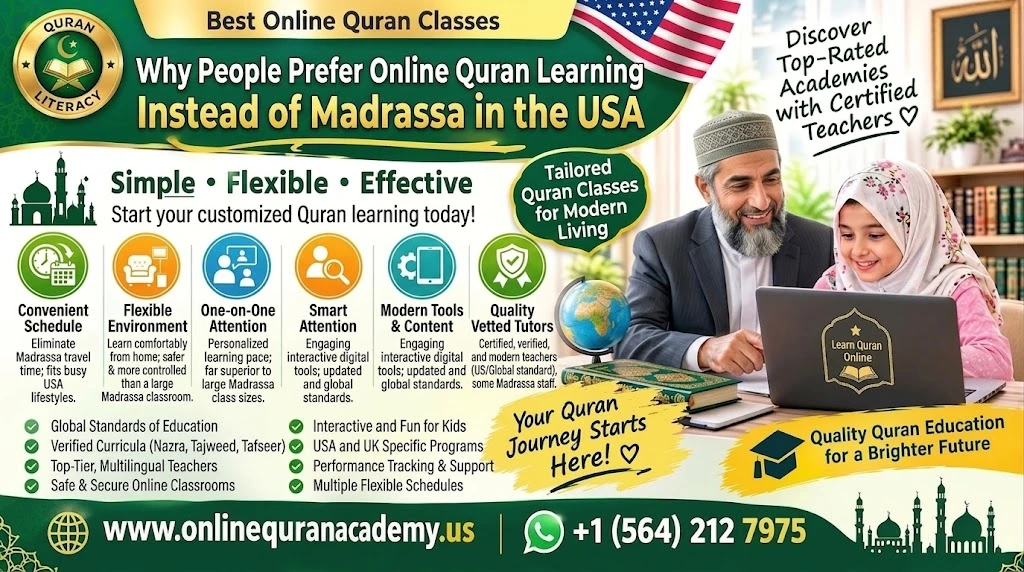
Across the United States, a quiet but significant shift is happening inside Muslim households. For decades, sending a child to the neighborhood madrassa after school was the only realistic way to learn the Quran. Today, more American Muslim families are choosing online Quran learning over the traditional madrassa model — and the reasons go far beyond convenience. From safety and personalized attention to certified tutors and flexible scheduling across time zones, online Quran classes have become the practical choice for busy American families who still want their children — and themselves — to build a real, lasting connection with the Quran.
This guide breaks down exactly why this shift is happening, what most “online vs madrassa” articles get wrong, what competitors leave out entirely, and how to choose a trustworthy online Quran academy in the USA in 2026.
Quick Answer: Most American Muslim families now prefer online Quran learning over madrassa because it offers one-on-one attention, flexible scheduling across US time zones, Al-Azhar certified tutors, female tutor options, transparent pricing, and a safe learning environment at home — without the commute, overcrowded classrooms, or inconsistent supervision common in some traditional madrassas.
What Is a Madrassa?
A madrassa (also spelled madrasah or madarsa) is a traditional Islamic school, usually attached to a local mosque, where children gather in person to learn Quran recitation, Noorani Qaida, basic Tajweed rules, and Islamic studies. For generations, the madrassa was the default option for Muslim families — largely because there was no real alternative. Students typically sit in group classes, often 15 to 30 children per teacher, following a fixed weekly schedule set by the mosque or community center.
What Is Online Quran Learning?
Online Quran learning replaces the physical classroom with a live, one-on-one virtual class connecting a student directly with a certified tutor through video call. Instead of driving to a mosque after a full school or work day, a student logs in from home and receives personal instruction in Quran recitation, Quran Tajweed, Quran memorization (Hifz), Tafseer, and Islamic studies — all scheduled around the family’s own routine.
Why American Muslim Families Prefer Online Quran Learning Over Madrassa
The reasons below go beyond the generic “flexibility and convenience” points repeated across most articles on this topic. Each one reflects a real, specific concern that American parents search for before choosing between a local madrassa and a structured online Quran academy USA.
1. Flexible Timings Across US Time Zones
Unlike a madrassa with one fixed evening slot, online Quran classes can be scheduled any time — early morning before school, right after homework, or on weekends. Families across the USA, from New York to California, can book a time that actually fits their day instead of rearranging family life around a mosque’s timetable.
2. One-on-One Attention Instead of Crowded Classrooms
Most competitor articles mention “personal attention” only in passing, without explaining what that actually means. A typical madrassa class has 15 to 30 students per teacher, while a single online Quran tutor works with one student at a time. Every mispronunciation is caught immediately instead of being missed in a crowded room.
3. Safety and Full Parental Visibility
Parents can sit beside their child during every lesson, request recorded sessions, and choose a platform where every tutor is screened before being allowed to teach. This is one of the biggest gaps in existing competitor content — very few articles explain what “safety” actually means in practice, such as background checks, monitored sessions, and no unsupervised one-on-one contact outside of scheduled class time.
4. Certified, Verified Tutors — Not Just Trusted Community Members
Local madrassa teachers are often respected community members, but they are not always formally certified in Tajweed or Qiraat. Reputable online platforms verify their Al-Azhar certified Quran tutors in Tajweed, Hifz, and Arabic recitation before they ever teach a live class, giving parents a level of proof that a walk-in madrassa rarely offers.
5. Female Quran Tutors for Girls and Women
This is one of the most searched — and most underserved — topics in the “online Quran learning vs madrassa” conversation. Many madrassas do not offer a female-only class option, especially in smaller US cities. Platforms with a dedicated female Quran tutor in USA program give girls, women, and reverts a comfortable, private learning space that many local mosques simply cannot provide.
6. No Commute, No Wasted Family Time
Driving to and from a madrassa two or three evenings a week adds up to hours of lost family time, plus fuel and parking costs. Online learning removes the commute entirely: class starts the moment the student logs in from a phone, tablet, or laptop.
7. Personalized Learning Pace and Curriculum
A madrassa generally follows one curriculum for the whole group. Online platforms build an individual plan instead: a beginner starts with Noorani Qaida, a fluent reader moves into Tajweed and Tafseer, and a Hifz-track student focuses purely on memorization and revision, without waiting for the rest of a group to catch up.
8. Access to Qualified Qaris Regardless of ZIP Code
Not every US city has a mosque with a native Arabic-speaking Qari on staff. Online Quran learning removes the ZIP code problem completely; a family in a small town in Ohio or rural Texas gets the same access to a qualified tutor as a family in Dearborn or New York City.
9. Multilingual Support for Reverts and US-Born Children
Many children raised in the United States are more comfortable in English than Urdu or Arabic, and reverts to Islam often start with no background knowledge at all. Multilingual tutors who teach in English, Urdu, and Arabic — a detail most competitor articles never mention — make a real difference for reverts learning Quran in the USA and second-generation Muslim kids who grew up speaking English at home.
10. Technology That Actually Improves Learning
Screen sharing, digital Mushaf highlighting, session recordings, and progress reports let both the tutor and parent see exactly where a student is struggling — something a madrassa teacher managing a full room of children rarely has time to document consistently.
11. Lower Real Cost Once Everything Is Counted
On paper, some madrassas look free or low-cost. Once fuel, time off work, fees for multiple children, and informal donations are added up, many families find structured online Quran classes for kids in USA with transparent course pricing are actually more cost-effective, especially with sibling and multi-course discounts.
12. Free Trial Classes Remove the Risk
Committing to a teacher blind is one of the biggest hesitations parents have. A free trial Quran class lets a family test a tutor’s teaching style, communication, and patience with their own child before paying anything — a low-risk way to decide if online learning is the right fit for a specific child.
Common Myths About Online Quran Learning — Busted
Most competitor articles mention one or two myths in a single sentence without real explanation. Here are the ones American parents actually search for and ask about before enrolling.
Myth: “A teacher can’t correct Tajweed mistakes through a screen.”
Fact: HD audio and screen-shared Mushaf pages often make it easier to isolate a single word or Makhraj mistake than in a noisy classroom full of children reciting at the same time.
Myth: “Online classes are only good for reading, not memorization.”
Fact: One-on-one Hifz programs let a tutor test retention every single session, something a teacher splitting attention across 20 students cannot do consistently.
Myth: “Learning the Quran only counts if it happens inside a mosque.”
Fact: Islamic scholarship does not tie the reward of learning to a specific building. The intention and sincerity of the student matter, whether the lesson happens at a mosque or on a video call at the kitchen table.
Myth: “Online tutors aren’t real scholars.”
Fact: Reputable academies publish tutor credentials, including Al-Azhar or Ijazah certification, so parents can verify qualifications before enrolling — something a home-run neighborhood class rarely offers in writing.
Online Quran Learning vs Madrassa: Quick Comparison
| Factor | Online Quran Learning | Traditional Madrassa |
| Class size | One-on-one, 1 student per tutor | 15–30 students per teacher |
| Scheduling | Flexible, any US time zone | Fixed evening/weekend slot |
| Safety oversight | Parent can monitor every session | Limited direct visibility |
| Tutor verification | Certified & background-checked | Varies by mosque |
| Female tutor option | Widely available | Rarely available |
| Commute required | None | Yes, 2–3x per week |
| Learning pace | Personalized to the student | Fixed group pace |
| Cost transparency | Published, fixed packages | Mixed fees / donations |
| Access | Any US city, town, or rural area | Depends on nearby mosque |
When a Madrassa Might Still Be the Right Choice
To be fair — and this is something almost no competitor article does honestly — a madrassa still has real value. A well-run local madrassa offers face-to-face community bonding, group prayer experience, and social friendships that a screen cannot fully replace. Families with a strong, safe, well-staffed mosque nearby, and a child who genuinely thrives in group settings, may find a hybrid approach works best: madrassa for community and Friday gatherings, online Quran learning for kids for structured, one-on-one Tajweed and Hifz progress during the week.
How to Choose the Right Online Quran Academy in the USA
Use this checklist before enrolling a child or signing up as an adult learner:
- Verify tutor certification (Al-Azhar, Ijazah, or an equivalent recognized credential)
- Confirm background checks and session monitoring policies are in place
- Ask whether a female Quran tutor option is available if needed
- Look for a free trial class before any payment is required
- Check for a transparent, published fee structure with no hidden costs
- Confirm class recordings or written progress reports are provided
- Make sure tutor availability actually covers your specific US time zone
- Review the full list of courses offered, including Tajweed, Tafseer, and Hifz
Real Parent Concerns and How Trusted Academies Address Them
“Is my child actually safe on camera?” — Reputable academies monitor sessions, restrict communication to scheduled class time, and welcome a parent sitting in on any lesson.
“What if my child gets distracted at home?” — Short, focused one-on-one sessions with an engaged tutor typically hold a child’s attention better than a shared classroom with 20 other distractions.
“What if the tutor isn’t actually qualified?” — Ask for certification proof up front; platforms with nothing to hide will provide it before the first paid class.
“What if my child doesn’t get along with the assigned tutor?” — Established academies allow parents to request a different tutor without penalty, something rarely possible in a fixed madrassa class.
The Future of Quran Education in the United States
As the Muslim population in the United States continues to grow outside traditional hubs, demand for accessible Islamic education beyond a single local mosque keeps rising. Many mosques themselves are now beginning to offer hybrid options, combining in-person community gatherings with structured online Quran classes for day-to-day learning. This blended model looks increasingly like the long-term direction of Quran education across the USA — not online replacing madrassa entirely, but online solving the access, safety, and consistency problems that traditional madrassas have struggled with for years.
Conclusion
The shift toward online Quran learning isn’t about replacing tradition — it’s about solving real, practical problems American Muslim families face every week: inflexible schedules, inconsistent safety oversight, crowded classrooms, and limited access to certified, native-speaking tutors. For families ready to give their children (or themselves) focused, one-on-one Quran education from home, Online Quran Academy in USA offers Al-Azhar certified tutors, flexible US-friendly scheduling, and a free trial class to experience the difference firsthand.
Book your free trial class today and see why more American families are choosing structured online learning over the traditional madrassa model.
Frequently Asked Questions (FAQs)
Q1. Why do people prefer online Quran learning instead of madrassa?
American families choose online Quran learning over madrassa mainly for flexible scheduling, one-on-one attention, certified tutors, safety oversight, and access to a qualified tutor regardless of ZIP code.
Q2. Is online Quran learning as effective as madrassa?
Yes, and often more so for individual progress. One-on-one instruction allows a tutor to catch mistakes immediately and track memorization retention every session, which is harder to do consistently in a large madrassa class.
Q3. Is online Quran learning safe for children in the USA?
Reputable online Quran academies use monitored sessions, verified and background-checked tutors, and allow parents to sit in on any class for full visibility.
Q4. How much does online Quran learning cost compared to a madrassa?
Costs vary, but online classes usually have transparent, published pricing. Once fuel, time, and informal madrassa donations are factored in, online learning is often comparable or more affordable, especially with sibling discounts. See current course fees.
Q5. Do online Quran academies offer female tutors?
Yes. Many platforms provide a dedicated female Quran teacher option for girls, women, and reverts who prefer a female-only learning environment.
Q6. Can adults learn Quran online in the USA?
Yes. Online Quran programs are designed for kids, teens, and adults, including complete beginners who have never read Arabic before.
Q7. What is the difference between Hifz at a madrassa and online Hifz?
Online Quran memorization (Hifz) gives one-on-one revision testing every session, while madrassa Hifz classes typically split a teacher’s attention across many students at once.
Q8. Are online Quran tutors certified?
At established academies, yes. Look for Al-Azhar certification or an equivalent Ijazah, and ask the academy to confirm credentials before your first paid class.
Q9. What if my child gets distracted during online classes?
Short, focused one-on-one sessions with an engaged tutor generally hold attention better than a shared classroom. Most academies also keep lessons interactive with visuals and direct questions to maintain focus.
Q10. Can beginners with no Arabic background join online Quran classes?
Yes. Beginners typically start with Noorani Qaida to learn Arabic letters and basic pronunciation before moving into full Quran recitation.
Q11. Is there a free trial for online Quran classes?
Most reputable academies, including Online Quran Academy, offer a free trial class so families can evaluate the tutor before committing to a paid plan.
Q12. What equipment do I need for online Quran learning?
A smartphone, tablet, or computer with a stable internet connection and a video calling app such as Zoom or Microsoft Teams is all that’s required.
Q13. How long does it take to memorize the Quran online?
It typically takes between 1 and 5 years depending on age, daily study time, and consistency. For a full breakdown, see How Long Does It Take to Memorize the Quran.
Q14. Can online Quran classes accommodate different US time zones?
Yes. Since classes are one-on-one and scheduled individually, tutors can accommodate Eastern, Central, Mountain, and Pacific time zones.
Q15. Is online Quran learning suitable for reverts to Islam?
Yes, and it’s often ideal. Many platforms offer English-medium instruction designed specifically for beginners. Learn more in our guide to Online Quran Classes for Reverts in USA.
Q16. What is taught in Noorani Qaida classes online?
Noorani Qaida covers Arabic letter recognition, correct pronunciation (Makharij), and basic Tajweed rules needed before reading the full Quran.
Q17. Can siblings learn together in one online class, or do they need separate sessions?
Most academies recommend separate one-on-one sessions per child so each student gets personalized pacing, though some offer sibling scheduling discounts.
Q18. How do online tutors correct Tajweed mistakes remotely?
Tutors use screen sharing, a digital Mushaf, and clear HD audio to point to the exact word or letter and demonstrate the correct pronunciation in real time.
Q19. Is madrassa better for building community among Muslim children?
For in-person social bonding and group prayer experience, a well-run local madrassa still has an advantage, which is why some families choose a hybrid of madrassa plus Learning Quran Online.
Q20. What platforms are used for online Quran classes?
Most academies teach via Zoom, Microsoft Teams, or Skype, depending on the family’s preference and internet setup.
Q21. How do I know if an online Quran tutor is qualified?
Ask the academy directly for certification documents, such as Al-Azhar credentials or an Ijazah in Tajweed and Qiraat, before enrolling.
Q22. Can I switch my online Quran tutor if it’s not a good fit?
Yes. Reputable academies allow parents to request a different tutor at any time without penalty if the current match isn’t working well.
Q23. Do online Quran academies teach Tafseer and Islamic Studies too?
Yes. Beyond recitation and memorization, most platforms also offer Tafseer, Quran translation, daily supplications, and basic Islamic studies.
Q24. Is online Quran learning recognized as valid Islamic education?
Yes. Islamic scholarship does not restrict the reward of learning to a specific location; sincere study of the Quran online with a qualified tutor is fully valid.
Q25. How do I start online Quran classes with a certified academy in the USA?
Simply contact the academy, choose a course such as recitation, Tajweed, or Hifz, and book a free trial class to get started. Trustpilot Reviews
